Queer Mutiny Flyer
1 media/Screenshot 2026-04-12 at 18.13.30_thumb.png 2026-04-12T22:14:18+00:00 Connie Pearson 439b2c5080350d71ce48ceea0c04ab259405290f 69 2 A flyer by Queeruption 2003 A flyer calling to protest and party outside Pride in the Park with pirates and a pirate flag in the background plain 2026-04-12T22:14:43+00:00 Connie Pearson 439b2c5080350d71ce48ceea0c04ab259405290fThis page is referenced by:
-
1
2026-04-11T19:47:36+00:00
A Girl's Guide to Fighting Fascism: Research Creation
9
How can we visually oppose fascism through zine creation
plain
2026-04-12T22:55:39+00:00
Research Creation: How to visually oppose fascism.
Introduction:
The research question I have chosen was how can we visually oppose fascism? I wanted to explore how we can create anti-fascist imagery and present three main arguments in how we can fight fascism. My work presents three ways arguments: violent action, partying and returning to nature. My approach is based on popular historical imagery, such as the Punk movement, and more current cultural movements like partying as a form of resistance.
As this was a research creation project, I wanted to engage with a medium that has a history with anti-fascist and cultural movements. I chose to make a zine as I found it has a rich history of independent expression within political and cultural movements. Zine can be defined as “noncommercial, nonprofessional, small-circulation magazines which their creators produce, publish and distribute themselves” (Duncomb, p.10-11). By engaging with the zine form, I situate my work in the context of sub-culture movements that thrive on independent expression. As zines are independently produced, they allow for a full range of expression outside of the mainstream. They give voices to voiceless communities. In my research, I found zines were particularly popular in Queer political movements as a mode for organising, spreading information or simply being funny.
The following essay will explore the research creation process and how the creation of a zine has helped discuss ways to fight the rise of fascism. The essay will then discuss how the form of the zine allows a distinct lens on fighting fascism, typical of independent publishing. This will be followed with an exploration of the cultural and historical contexts that my work is placed in by being a zine.
The Research Process
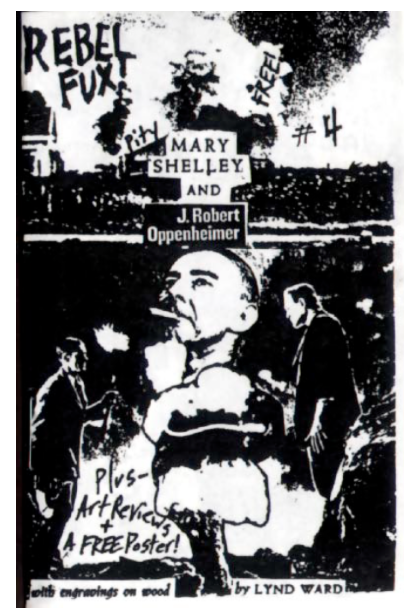
The research process began with looking into zine archives on the internet. I began here as I felt that would provide good context into popular recurring images and themes. A particular favourite archive of mine was Queer Zine Archive Project (QZAP) and I found some extremely interesting zines and political flyers. One series I found was called “Rebel Fux” by Kate Huh (QZAP, 2024). Edition number four by Lynd Ward draws a connection between Mary Shelley’s Frankenstein and Oppenheimer in a conceptual exploration “the modern Prometheus myth and the creation of a weapon of death” (QZAP, 2024).
I found this extremely inspiring as the zine presented an argument against nuclear weapons mostly through images and limited text. It’s a highly conceptual way of presenting a sound political argument. This is one way in which the zine form allows for political commentary which I took note of.
(Figure 1: Rebel Fux #4, Mary Shelley and J. Robert Oppenheimer, Lynd Ward)
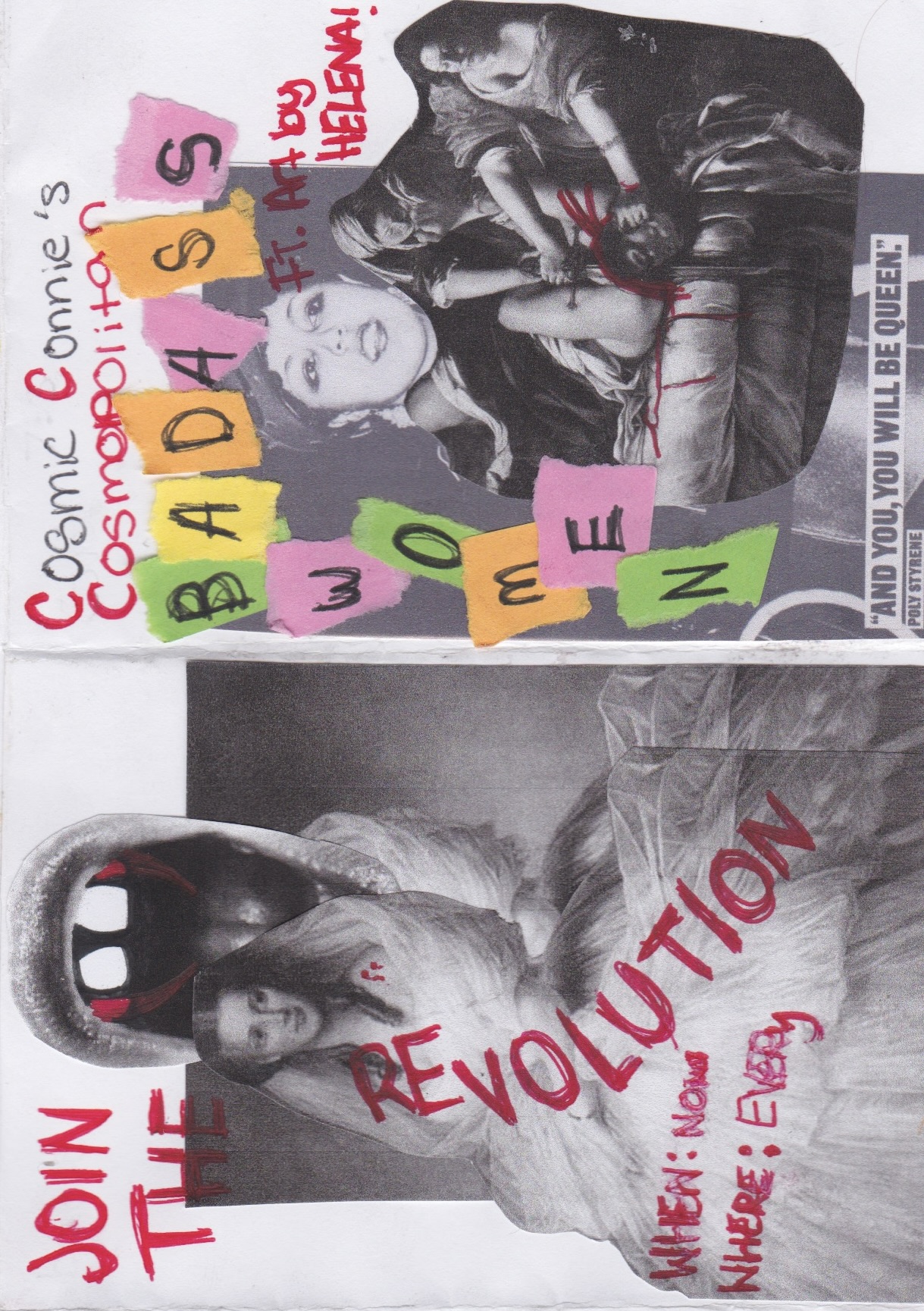
Another part of my creation process was looking back at a few of my own zine creations. I had made some, arguably cringe-worthy, zines in 2021, trying to emulate the punk look that a lot of zines have. I remember really enjoying the process of making them by hand with printed images and collaging them together. I also remember working in collaboration with my friends as they would create art to go in the middle of the zine that could be used as a mini poster.
Fig 2: Connie Pearson, 11/03/2021
I formulated my arguments on fighting fascism mostly based on sub-cultures like the punk movement and conversations I shared with my flatmate. My three main concepts were: violence, dancing and nature. I chose the punk sub-cultures as it is the most visually noticeable style in zines. Popularised in the 1970s and 1980s, punk fans “started printing fanzines about their music and cultural scene” as they were critical of the mainstream (Duncomb, p.11) This can still be seen today in punk movements such as the collective, Denpasar Kolektif, in Bali (Anggawi, p.59). The group are well known for using “zineing” as “a main pillar of their work” and a way of sharing political information, organising for their community and sharing art and poetry (Anggawi, p.60). As such, I wanted to use punk imagery for the beginning of my zine to explore action against fascism.
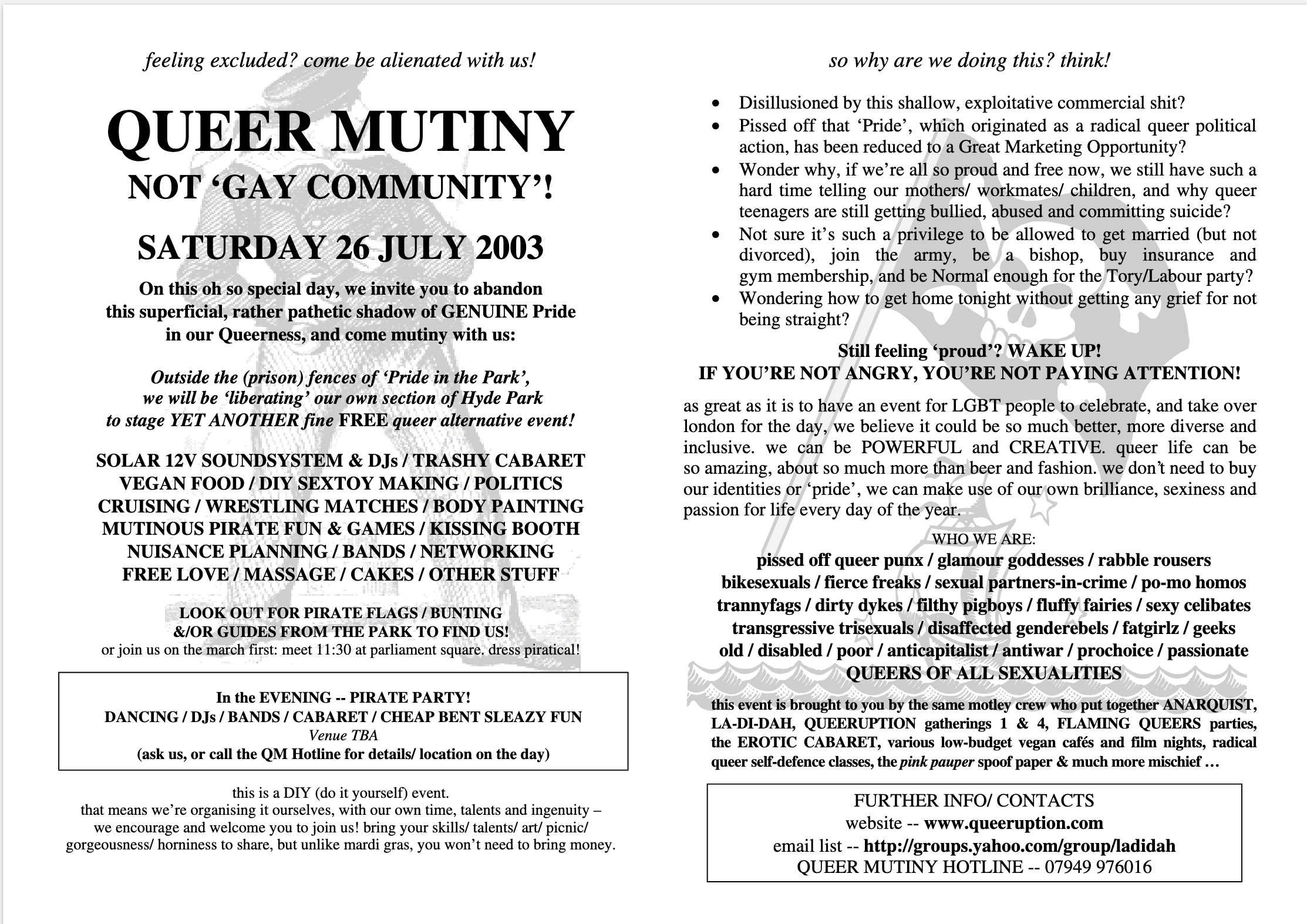
Through conversations with my flatmate, we discussed the importance of third spaces and partying as a form of resistance. Whilst it may sound like we are just university students who love to party, I believe that experiencing joy in a community setting is a revolutionary act, especially being part of the lockdown generation when community was lost for a lot of our youth. For example, I found this leaflet for “Queer Mutiny”. It was a protest against the “superficial” Pride in the Park event. Importantly, it combines sound systems and partying with a political stance which I believe shows how partying is a form of resistance. Importantly, “queerness” is “necessarily anti-fascist, revolutionary, and intersectional” and tied up with anti-fascist movements (Hamilton, p.61). Expressions of Queerness are tied up with anti-fascist political movements and expressions of joy. As such, partying is a form of resistance.
Fig 2: Queer Mutiny Flyer (2003) from QZAP
Finally, we often discusses being in nature and how much peace it brings us. Both of us are city kids by birth, but have realised the importance of reconnecting with nature, especially during our exchange in Toronto as it can be quite a grey city. There is something revolutionary in wandering and frolicking aimlessly outside of the confines of a grid system. The fascist’s cannot get to you when you’re happy and free in the wilderness. Through looking through zine archives, a recurring topic are people’s journeys hitchhiking. The aimlessness of hitchhiking and its detachment from systems of money is an anti-establishment mode of travel. This connects well with the anti-establishment ethos of zineing. It could be argued this also engages with the tradition of “flânerie” as a rejection of strict urban confines.
The Creation Process
When I began making my zine, I started the process with by cutting up old books. The front cover was made by hand by collaging together found images. I thoroughly enjoyed the process but found I did not have enough resources on hand to finish this (I’m living away from home and my hoarded collection of scrap paper). As such, I decided to finish the zine digitally using Canva. “Digital technologies and online platforms” have historically aided the “expansion of zine-making tools” which I find to be highly agreeable (Baker, Cantillon, 2022, p.542). I found this process was simpler as it allowed me full access to the internet. However, it was not as therapeutic as working by hand.
Working digitally also aids “possibilities for distribution” (Baker, Cantillon, 2022, p.542). This opens up for wider distribution and audiences as the Internet can target audiences across the globe. Traditionally, zines would be distributed locally at events or mailed to subscribers. However, the internet allows for wider distribution, with many zines available to download for free. This means the proliferation of information is cheap or free and available to an international audience. Working digitally and making digital scans of any paper parts of my zine opens up my research project to a larger audience.
I aimed to emulate the conceptual expression of an argument that I saw in “Rebel Fux #4” by blending my three arguments together. I wanted to structure my zine to show how the arguments progress from violent action into partying into nature. This was with the aim of showing how the arguments to fight fascism work together. From my research above, my arguments were based on repeated imagery I had noticed in zines and leaflets of anti-fascist movements.
I thought about repeated imagery that could be carried through the zine to show the progression of the arguments as well. I liked the images of the snarling dogs turning to lambs frollicking, to a dog dancing to horses running free. The use of collage helped with this as I enjoyed out of place imagery like lambs dancing in a club scene.
Furthermore, I thoroughly enjoyed the affordances zines allow with creative expression. As they are independently made, zines do not have a governing structure to censor and allow for full, independent expression. This works well with extreme arguments like calls to violence. The imagery of violence is an expression of resistance to the violent systems of fascism.
Cultural and Historical Context:
My research creation project exists in the historical context of independent zine making as a form of rejecting the mainstream. Zines first existed as “fanzines” popular amongst Science Fiction fandoms which was then cooped by “fans on punk rock music” (Duncomb, p11).
I would argue that this radical expression of opposition to the mainstream could be connected to the pamphleting tradition of the Protestant Reformation and English Civil Wars. Political opinions that were contrary to the Church or the Monarchy were distributed by normal people. This would not have been possible without the invention of the printing press which created the opportunity for the distribution of knowledge outside of the Church.
This level of independent political expression through printing can be seen through groups like the Gay Liberation Front (GLF). One example of this was their 1972 zine “Lesbians Come Together” that opposed the “reformist wing of cisgender gay men and middle-class activists” in the GLF (Hamilton, 64). Their expression of political opinion also allowed for complex discussions that “heteropatriarchy” was a “source of fascism” and an “ideological prop for the status quo” (Hamilton, 64). The GLF highlighted the connection between the Nazis persecution of Queer people in the 1940s and the attacks from the National Front in the 1970s. Zineing was a mode of organising and protecting the Queer community by presenting political theories that would may not have been seen in the mainstream.
Zines also exists within the context of DIY culture. The ethos of individuals or small collectives making “decidedly amateur” publications for cheap or free is central to zines (Duncomb, 18). As “zines are part and parcel of this DIY ethic” they allow expression outside of “what is commonly called ‘the system’” (Anggawi, 67)
They exist outside of the confines of money and are made entirely for the “love of expression, love of sharing, love of communication” (Duncomb, 18). Their existence outside of the establishment and systems of money is what allows zines to have complete independent expression. This is important for political expression because it creates an uncensored platform for opinions. Anyone with any opinion can create a zine to distribute and that is the beauty of it. The DIY nature of it sets no limits on creative expression.
Conclusion:
Zine creation allows for the full exploration of a critical question as it is marked by independent artistic expression. As zines are independently made and engage with DIY culture, they allow for an in depth look into a critical question outside of the established mainstream. Furthermore, by engaging with the zine tradition, my research creative process was placed in the historical and cultural context of sub-cultures and political movements that benefited and relied on independent expression. As zines are amateur, they exists outsides the confines of systems of money, allowing for organic and authentic expression. This also creates a platform for complex and varied political expression. As such, the medium of the zine allows for arguments to be explored around how we can fight fascism.
Images in this online publication are either in the public domain or are being used under fair dealing for the purpose of research and are provided solely for the purposes of research, private study, or education.
Bibliography:
Anggawi, Sophie Mahakam. ‘Products of Protest? The Creative Protest Potential of Zines on Bali’. The Asia Pacific Journal of Anthropology, 23:1, 59-77, https://doi.org/10.1080/14442213.2021.2001033
Baker, Sarah, and Zelmarie Cantillon. ‘Zines as Community Archive’. Archival Science [Dordrecht], vol. 22, no. 4, 2022, pp. 539–61. torontomu.primo.exlibrisgroup.com, https://doi.org/10.1007/s10502-022-09388-1.
Duncomb, Stephen. ‘Notes From Underground: Zines and the Politics of Alternative Cultures’, 1997
Hamilton, Rosa. ‘The Very Quintessence of Persecution’. Radical History Review, vol. 2020, no. 138, Oct. 2020, pp. 60–81. DOI.org (Crossref), https://doi.org/10.1215/01636545-8359259.
QZAP. Rebel Fux #4: Where Creations End Their Creators - QZAP - The Queer Zine Archive Project. 24 Oct. 2024, https://gittings.qzap.org/rebel-fux-part-1/.