The Great Day of His Wrath
1 media/width-1440_dAaH0JO_thumb.jpg 2026-04-12T03:10:59+00:00 Emiliano Gonzalez Carranza 7894cd5fc0ef037dd7fe886eb3d7a88d42fcf1e8 74 1 Painting by Martin, John. 1851, Tate Museum, London. plain 2026-04-12T03:10:59+00:00 Emiliano Gonzalez Carranza 7894cd5fc0ef037dd7fe886eb3d7a88d42fcf1e8This page is referenced by:
-
1
2026-04-12T01:01:13+00:00
Digital Spectatorships and the Value of Theatrical Exhibition
18
plain
2026-04-12T03:29:38+00:00
Introduction
The film industry’s modes of production and exhibition are ever-evolving, influenced by the governing form of visual culture. Technological advancements affect the act of spectatorship. When movie theatres used to be the only way to watch movies, the television invited people to stay home. Then came the advent of color, of home video formats like Laserdiscs, VHS, and DVDs. As a result, the act of spectatorship is much different from what it used to be, given our shifting visual culture. In the 21st century, it could be argued that short-form vertical video content might be the dominant form of video consumption, so what does that mean for the production of cinema, from big Hollywood releases to independent films? When anyone with a camera-equipped smartphone be able to produce short and feature length films with enough effort? It is imperative, however, to remember that audiences have shifted, too. The internet has enabled them to go global, and fandom culture invites one to become a passionate spectator of anything, anywhere.
Scale will be a recurring theme in this paper. The financial scale of today’s films is gargantuan compared to what Hollywood used to spend, though the average quality has arguably diminished. The internet has enabled studios and filmmakers to pursue worldwide audiences, and these audiences are now generally equipped with tools to produce their own work with smartphone equipment. The scale at which streaming services irreversibly disrupted the traditional filmmaking and watching processes.
This paper aims to examine these industrial and cultural conditions of our screen-first popular culture in order to provide a deep, contextualized understanding of the driving forces behind the 21st century’s cinema, looking at movie theatres as communal, tangible third spaces – especially with blockbuster films that draw massive crowds and spark conversations on social media, focusing in particular on IMAX theatres as ideological counterparts to streaming, able to evoke the Burkian Sublime in films like the recent Denis Villeneuve Dune films, as well as draw massive crowds for polar opposite films like seen with Christopher Nolan’s Oppenheimer and Greta Gerwig’s Barbie.Blockbuster Cinema as a Third Space
If the proliferation of screens means cinematic consumption is no longer attached to the movie theatre, what happens to the building itself? What purpose does it begin serving? Though their practical value and prestige will never be what it once was, they still hold tremendous value as social spaces. On this topic, Rösener writes, “movie theaters do not impose exclusions based on economic or cultural capital – for example, there is no etiquette, no dress code, no required prior knowledge, and no expected behavior: The darkness of the cinema space, they noted, allows people to be themselves – unobserved and unjudged" (8.)
Since our attachment to technology has evolved to the point where distancing oneself from it for one’s physical and/or mental wellbeing is also an accepted fact of life now, the appeal of the theatre as a liminal space where distractions and control are surrendered in exchange for greater mental action and empathetic reaction for a few hours becomes clearer, too. To continue this exploration in greater detail, I will outline two very distinct kinds of theatrical exhibition:
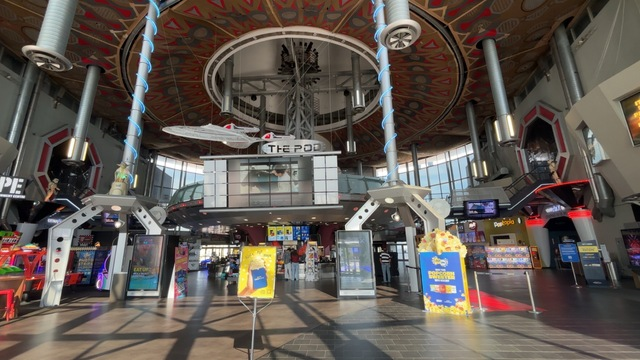
1. Medium-to-large corporate multiplexes with plenty of concessions and choices in films and formats to see them in - 3D, ScreenX, etc. The example below is the lobby of the Cineplex Cinemas Vaughan location – formerly the Famous Players Colossus. Upon entering, visitors are flanked by arcade games and faced with a 360-degree concessions stand at the center of the building, unmissable on the way to any of the 19 screens inside.When we discuss these, we discuss locations like Cineplex, which incidentally controls 80% of the exhibition market in Canada.
For comparison, the two largest theatre chains in the United States – AMC Theatres and Regal Cinemas – enjoyed market shares of 23% and 15.3% in 2024 respectively (D’Alessandro). “While most companies profit from their own products, cinemas face a dilemma: they neither control the product nor its success. Like other cultural institutions, cinemas have no influence over the cultural products they present, but in contrast to most subsidized cultural institutions, they rely on earning money with what the market provides,” writes Rösener (9), and so the uneasy tension between a place which is supposed to represent art and culture and its capitalist purpose to charge their patrons as much as possible clarifies the malaise surrounding them for years. With a declining worldwide economy and the threat of other visitors ruining one’s experience with poor theatre etiquette (so much so that announcements reminding people not to use their phones or talk in the middle of the movie are commonplace), it’s easy to understand why people would be unwilling to invest their time and money into them.
So then, it’s time to consider an alternate mode of theatrical exhibition which has been gaining traction worldwide in recent years, particularly in Toronto.
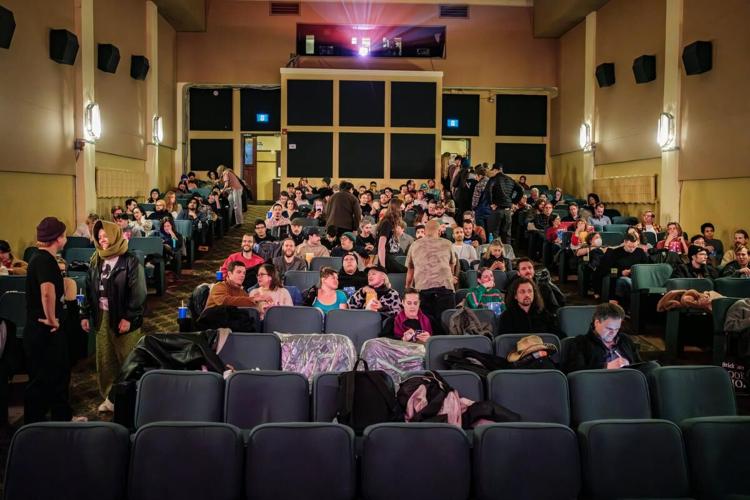
2. Small-to-single screen theatres which are often independent and “establish themselves as independent cultural venues – each with its own voice, community, and mission,” according to Rösener (2). Though his insights are focused on German-speaking countries, I offer the example of Toronto’s oldest operating theatre, the not-for-profit Revue Cinema. In opposition to the multiplex model, its programming is repertory-based, meaning that while it does play new releases, it does so in a limited, second-run fashion after they’ve played at Cineplex and prioritizes daily event screenings of older films.
Though the purposes of the first kind of cinema is to extract as much profit as possible from its visitors through concessions and ads and premium format markups, the Revue offers an art-first alternative to film enthusiasts in Toronto, and similar theatres around the world do the same, like the Cinema Trindade in Porto, Portugal, the Cine Tonalá in Mexico City, or the Cine Doré in Madrid, Spain. While their services and programming differ slightly (European cinemas offered no concessions at all outside of multiplexes), the core idea of an alternative moviegoing experience which prioritizes choices outside of the mainstream has generated a lot of business in recent years, particularly among younger crowds.
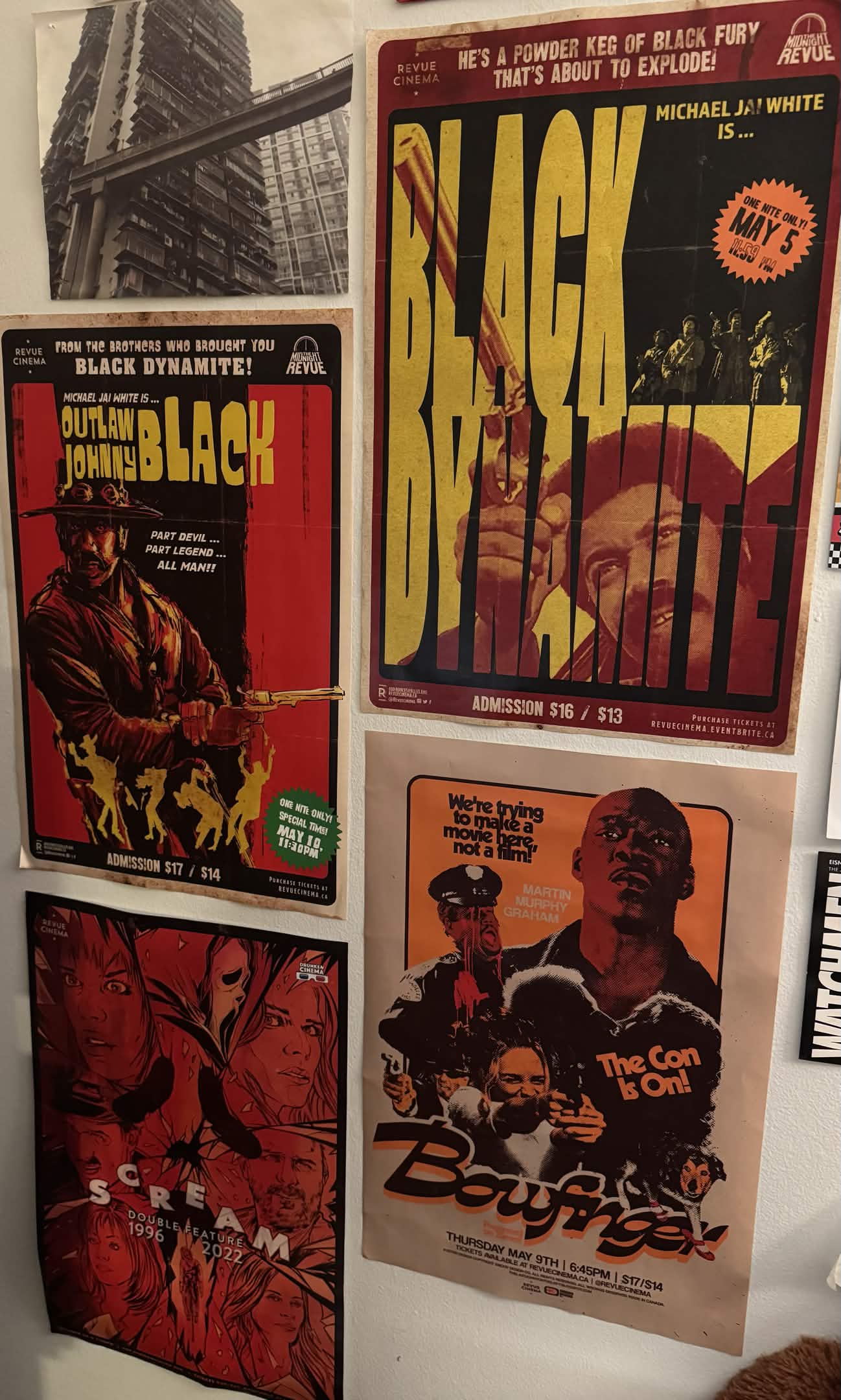
In an article about Toronto’s booming repertory cinema scene, Corey Atad wrote: “It’s becoming a bit trendy to go to repertory screenings because they’re more event-based than going to the multiplex,” said Whitney [programming director at the Revue], suggesting that young people have also been inspired by romantic cinematic depictions of characters attending screenings at older independent theatres. The Revue offers monthly series like the horror-centric Nightmare Alley; the neo-noir soaked Neon Dreams; and the fun and rowdy Drunken Cinema. Then there’s Dumpster Raccoon, a series featuring “trashy” cult films and live performances before each movie; in December, there’s a singalong screening of the notorious 2019 bomb ‘Cats.’” The Revue also sells posters for most of the films they showed, with original art commissioned from independent, usually local artists.
It’s clear people are more willing to invest their time and money into the theatrical experience when it is suffused with cultural meaning, and it highlights the importance of theatres as a social space. On this topic, Rösener writes, “movie theaters do not impose exclusions based on economic or cultural capital – for example, there is no etiquette, no dress code, no required prior knowledge, and no expected behavior: The darkness of the cinema space, they noted, allows people to be themselves – unobserved and unjudged" (8.) Since our attachment to technology has evolved to the point where distancing oneself from it for one’s physical and/or mental wellbeing is also an accepted fact of life now, the appeal of the theatre as a liminal space where distractions and control are surrendered in exchange for greater mental action and empathetic reaction for a few hours becomes clearer, too. “Whereas it would be impossible to determine why some viewers valorize and enjoy slowness while others do not, the historical and geopolitical supremacy of a narrative cinema informed by the principles of functionality and efficiency points to a larger set of anxieties and suspicions surrounding slow time in capitalist modernity. After all, good films, or so we hear in common parlance, are precisely those that make us unaware of the temporality of their projection, those in which time passes by without one's noticing” (De Luca, 29).
None of this is to say, however, that multiplexes are exclusively soul-sucking ventures devoid of any form of cinematic joy or that independent theatres are supposed to single-handedly maintain an appetite for analog projection in an increasingly digitized world for generations to come. Their opposing programming philosophies mean more choice for consumers and film enthusiasts, as evident in the simultaneous July 21, 2023 release of Christopher Nolan’s Oppenheimer and Greta Gerwig’s Barbie. This coupling of aesthetic and thematic opposites was dubbed Barbenheimer on social media, quickly becoming a phenomenon that inspired “teen boys in pastel pink tuxedos to catch the double bill; cosplayers donning outlandish cartoon costumes; hybrid outfits redolent of Victor/Victoria’s (1982) gender-fluid garb; scores of people using Barbenheimer memes to tap into something of a collective online psyche that eschewed traditional notions of gender conformity. Rather than pitting the films against one another, discourse instead proffered the amalgamation of the films, and circumvention of any reductive battle-of-the-sexes comparison. It was the combination of the films, rather than their competition, that fuelled much of what was essentially free publicity for both” (Mitchell, 120).
Much of the phenomenon was driven by the incentive to go and document your local theatre’s version of Barbenheimer, to share pictures of what you and your friend chose to wear, etc. The pairing also speaks to one of the new lenses within which films are held under by popular culture: as malleable, living texts that are able to speak to one another through users on social media. Kata Szita offers a very helpful perspective on this nuance: “Through the broadening arsenal of screens, viewers have received a reliable supply of tools for watching and interfering with content simultaneously. In fact, portable smart devices have a great deal to do with establishing an alternative film industry, where users are able to create, access, and watch films and videos, to distribute them through social media, to browse for additional information, and to evaluate contents – on the very same personal multimedia platform. This means that anyone in possession of a smartphone can contribute to the wide palette of content by recording and sharing whatever they find relevant” (43).
As a result, there is no longer as uniform a cultural conversation as there used to be. Not everyone watches the same TV shows, the same movies, reads the same books (if at all), etc. This is not inherently negative, but the fragmentation of culture and the depth of the internet has undoubtedly created an entirely different framework which society uses to judge cinema. So, what happens for newer generations who don’t know of a daily life without screens or digital interaction?The New Spectatorships
It is my personal perspective that our visual culture is primarily dominated by screens, yes, but more specifically, short-form vertical video content. Social media apps like Vine and TikTok have inspired the integration of similar feeds into long-standing sites and apps like YouTube, Instagram and Facebook, to name a few. This has incentivized a further shortening of attention spans across generations, which has also passively devalued the cultural institution of “the movies,” reducing them to filler entertainment rather than art made to be seriously engaged with.
While the term ‘social media’ traditionally evokes text and image based social networks like Facebook, Instagram, or X (formerly Twitter), if we are to discuss modern spectatorship and cinephilia, the rise of Letterboxd cannot be overlooked. Its popularity among film enthusiasts, as well as an increased presence in press junkets on the professional side of the industry make it a useful case study in one of the film industry’s most successful attempts at keeping up with the visual culture and staying connected with younger, more online audiences. It is not a traditional social networking site in that there is no direct messaging or simple posts. A serviceable analogy is that of a digital journal, in which users are able to log what day of what month of what year they watched a movie on. Users then have the ability to write a review, add any desired tags to it (these then link to other entries with the same tags), a rating out of 5 stars (that allows for halves) as well as an optional heart-shaped ‘like’ button. These reviews can be public or private - if public, they can be seen by anyone on the site who looks up the relevant film, and users can follow others whose writing/reviews they like.
Personally, I never use the star rating system and adhere very strictly to the ‘like’ button as the only judgement of value on my profile. This is because I strongly believe numerical ratings of art forms are reductive and stagnate the opportunity for true critical discussion to occur, and there is an argument to be made that the popularity of aggregator websites like Rotten Tomatoes or Metacritic create an environment where an arbitrary, algorithmic number becomes the single deciding factor for a significant amount of the theatre-going population to decide whether to see a movie in theatres, wait for it to come on streaming at home, or skip it entirely. This is not to imply that film criticism/reviewing is useless, but rather that it is not being engaged with like it used to. For example, it’s difficult to imagine a show like Siskel & Ebert & the Movies today, where the entire point of the program was to watch two well-known, regarded film critics discuss their opinions on new releases at length, when the advent of the internet has shifted that responsibility to viewers themselves.
While social networks like Facebook or Instagram are able to host conversations about film among a plethora of other things, the discussion is entirely about cinema in Letterboxd, and it extends to these other social media platforms by way of their editorial staff’s work, publishing articles, lists, interviews, retrospectives, etc, but most popularly, they also publish a series of videos in which famous, relevant personalities in the film or entertainment industry select what 4 films would go on their Letterboxd profile, further encouraging others to delve into the site and the cinephilia it promises, perhaps subtly influencing the spectatorial choices of its users, as the ever-judging eye of social media tends to do. Ultimately, this can also lead to a kind of performative spectatorship in which one’s choices are dictated by what they will say about them on their profile.
This aesthetics-first form of spectatorship has also brought a lot of attention to a relatively underserved aspect of cinephilia in recent years: home video. Though a more thorough discussion of the slow death of physical media will be relevant later in the paper, a line of boutique releases known as The Criterion Collection is particularly relevant now.
It’s crucial to situate Criterion as another, smaller cultural institution within the confines of this new fandom-obsessed cinephilia despite the fact that they have been around since 1984, releasing in the VHS, Laserdisc, and DVD formats before transitioning to the now-standard Blu-Ray disc. As per the company’s website, their releases are “state-of-the-art restorations with special features designed to encourage repeated watching and deepen the viewer’s appreciation of the art of film.” Every month, new films are announced to be joining the collection, and its range is as varied as it is detailed.
Both Letterboxd and Criterion maintain a healthy social media presence through collaborative videos and interviews with relevant industry professionals. Letterboxd has a popular “Four Favorites” series which features press junket or red carpet interviewees being asked to select their four favorite films, as this is what every Letterboxd user is asked to do upon creating a profile, creating both demand and appeal for the app but also encouraging the viewing of a wide selection of films. The Criterion Collection, on the other hand, has a closet in their offices filled to the brim with their most recent releases which guests are invited to step into to select a handful of films to wax poetic about their selections, encouraging viewers to purchase their selections through a special page on their website marked “Criterion Closet Picks.” There is much overlap between the guests on these video series, as they are often working filmmakers promoting their latest projects, and the videos themselves are often cross-posted across several social media platforms, formatted to fit both widescreen and vertical video.
These companies have been embraced by young, avid cinephiles, so much so that recently, Criterion has been dispatching their new “Mobile Closet” to film festivals in North America so that attendees can visit the closet (for three minutes total) and even record their own video if they so desire. Visiting this consumer version of the Closet guaranteed one a tote bag, a printed pocket guide to its contents, and a Polaroid to memorialize the visit, all while supplies lasted, of course. No purchase was necessary, and it would not be difficult to imagine someone attending for these free goodies, but spending was incentivized through a 40% discount on the first three films.
There’s many different ways to observe this practice, but it’s difficult to deny the parasocial undertones to it all when one takes into account the cult of celebrity that has always surrounded Hollywood, further enabled by the internet. After all, it’s a big world out there, and now that streaming and social media allow one to stay connected to the relevant texts in pop culture as well as the discourse surrounding them, consumers are faced with a choice: investing time and money on a movie ticket in an age where free access to libraries of content is common place, even without streaming subscriptions. Cultural forces like Letterboxd and the Criterion Collection paired with the rising popularity of repertory cinemas, as discussed earlier, indicate a seemingly widespread interest in reviving the cinematic experience in the streaming age.
Because of this, it would not be inaccurate to say that for every new release, these opposing forms of viewership compete for each audience member there is to see it. There are theatre purists which prioritize the cinematic experience, as well as those who would much rather see it in the comfort of their own home.A Techno-Cultural Arms Race
It's important to separate studios from exhibitors, as though the latter are entirely dependent on the former, studios regularly license their catalogue to streaming services or even attempt to run their own, to varying degrees of success. The control that a streaming platform offers a studio has been attractive to several important Hollywood studios, and the original content produced for these is a driving factor in incentivizing customers to subscribe, even enabling tech companies like Amazon and Apple to gain a foothold into “prestige” television.
Watch in bed, on the train, on the toilet…with these, your watch time is tracked to a slim margin of error, so you can jump right back into an episode you stopped watching a few hours or even days ago, even across devices. Streaming services are entirely built around streamlining the spectatorial experience, and “premium” features like high resolution video and HDR are commonly available on high-end phones today, and costlier subscriptions to these services enables one to take advantage of these features on one’s device. But most importantly, an algorithm tracks the content you watch and pushes on more content you’ll respond to. This, in turn, informs the decisions made regarding the production and distribution of original content made by streaming services. This convenience certainly creates more opportunities for enjoying cinema or television in daily life, like on one’s commute, but it is also easier than ever to put something on for the purposes of distraction, as if our devices were merely video-capable radios.
The competition between streaming and theatres echoes the competition between the recently introduced television post WWII and theatres back then, which had to compete against a fascination with the advent of electronic appliances in the era and spent less on intangible/ephemeral products like movie-watching, so the idea to spend big to earn big in order to provide an experience the living room set couldn’t became their primary focus. As Langford puts it,“...in an era of occasional rather than habitual filmgoing, the right kind of pictures, promoted properly, could transcend the medium to become exciting ‘must-see’ events commanding exceptional public interest” (34). Widescreen formats like VistaVision, Cinerama, and others follow suit, all studio-specific in this day and age.
For home viewers, there was the advent of color, of home video formats like Laserdiscs, VHS, and DVDs. Today, we have Blu-ray Disc, primarily used for the physical distribution of video games, but originally developed for home video. There has been no higher-quality successor to a physical media format since the was introduced in 2006, unless one counts the Ultra HD Blu-Ray Disc, released in 2016, as its successor.
In a society where subscription services are the norm and physical ownership dwindles, it is difficult to imagine both the corporate development of a new physical media format or its eager adoption by consumers, as the advent of streaming services marked an incredible disruption to not just Hollywood, but the entire entertainment ecosystem. Simply look at what it has done to the music industry and artists’ livelihoods there. On the film side, it means that studios can no longer depend on the money made from home video releases.
During an appearance on the internet talk show Hot Ones to promote his 2021 film Stillwater, Academy Award-winning actor, screenwriter, and producer Matt Damon had this to say: “The DVD was a huge part of our revenue stream, and technology has just made that obsolete. And so, the movies we used to make, you could afford to not make all of your money when it played in the theater because you knew you had the DVD coming behind the release, and 6 months later, you’d get a whole ‘nother chunk – it would be like reopening the movie, almost. And when that went away…that changed the type of movies that we could make” (First We Feast, 14:20).
When the cost of advertising a film generally matches its production budget and half of the box office revenue must be split with exhibitors, a 25 million dollar movie suddenly needs to make 100 million dollars before the studio starts seeing profit, and it has made original stories with lesser-known actors become a much more risky venture in a pop culture environment saturated with franchises and without a reliable, secondary revenue stream.
This has largely transformed movie theatres into just one of many potential entry points into pop culture for a film, able to enjoy a life outside of the traditional theatrical window, similar to the heyday of home video, though the implications for the business are far different, as Damon’s comments clarify. Furthermore, his appearance on Hot Ones are emblematic of the indelible mark influencer culture has left on the wider entertainment industry, and promotional campaigns for blockbusters now regularly feature a familiar chain of outlets putting filmmakers and actors through Buzzfeed-quiz style interviews, echoing further the potential parasocial undertones discussed earlier.
Recent theatrical successes have proven the viability of the theatre as an event space for exhibitors, and the premium large format of IMAX theatres has been instrumental in tipping the scales. To pretend the Canadian corporation hasn’t been widely valued among industry professionals and exhibitors for decades now would be ill-informed, but the brand has acquired immense cultural value in recent years thanks to a surge in attendance provoked by the simultaneous release of the earlier-discussed Barbenheimer, in which Christopher Nolan’s 3-hour IMAX-ratio Oppenheimer was a central fixture of, and maintained by other films like Denis Villeneuve’s recent Dune trilogy and Ryan Coogler’s Sinners.IMAX and the Burkean Sublime
IMAX theatres represent the technological zenith of mass theatrical exhibition. Their theatres feature stadium-style seating and proprietary, high-resolution projectors with massive screens, designed to fit a 1.43:1 or 1.90:1 aspect ratio. The former aspect ratio was the one IMAX entered the market with, but the company has developed the latter ratio in order to accommodate smaller sizes of the screens in order to build more.
The difference between these theatres isn’t communicated to the consumer, so a customer in Toronto, for example, could be attending the Yonge-Dundas Cineplex’s IMAX screen for years without ever knowing that the Scotiabank Theatre just off of Queen Street has one of 4 full-size IMAX screens in all of Ontario.
This is a good opportunity to discuss the scarcity of IMAX theatres. Though there are 1,800+ of them in 90 countries (Weaver), the popularity of analog aesthetics has made IMAX 70mm film screenings a valuable commodity in the exhibition market place again since the industry’s transition to digital cinema packages over film reels. Of these 1,800+ screens around the world, there are only about 30-40 that possess a full-size 1.43:1 screen, and even fewer of those are equipped to project IMAX 70mm film.
So, all of this investment, all of this scale, all of this technology…for what, really? What drives audiences to pay the premium markup for it? It could be as simple as wanting to see a massive spectacle projected on the largest screen with booming sound, but I would offer the more nuanced explanation of them being one of our society’s most reliable portals to interacting with Edmund Burke’s concept of the Sublime, later redefined by Immanuel Kant.
Raymond McBride offers a helpful brief history of this concept through these article excerpts: “For Burke and his British contemporaries, the sublime was an aesthetic quality of nature and typically induced by vastness, obscurity, infinity, suddenness, and bodily pain; it is an astonishment of the soul in which reason is overwhelmed by sensations that threaten to undo the convictions underpinning an orderly worldview. Therefore the sublime heralds a degree of terror; but with terror that does not press too closely, he argues, comes delight (21). [...] The Kantian sublime is fascinating, wonderful, boundless, beautiful, dreadful, meditative, and enraptured. For both Kant and Burke, the sublime are those grandeurs in nature or works of fine art which are absolutely great and inspire feelings of limitlessness and infinity. This brings with it a kind of danger; but Kant differentiates physical from metaphysical danger. When we encounter wild insoluble feelings that surpass the power of our imagination to grasp them, we are in the realm of the sublime (22).”
Putting this in concert with Van Wyk’s exploration of the contemporary cinematic sublime, she finds that “For both Kant and Burke, the sublime is something that must be experienced at a distance. But somehow, cinema breaks through this barrier by evoking both an ontological state of bodily groundedness (immanence) and at the same time taking the subject beyond the present (transcendence). In yet another paradox, the cinematic sublime provides this experience not through presentation but re-presentation. The cinematic sublime is not ‘real’; it is fiction but it still evokes responses that feel real, even though these responses are triggered by a ‘false’ experience, such as that provided by special effects” (45).
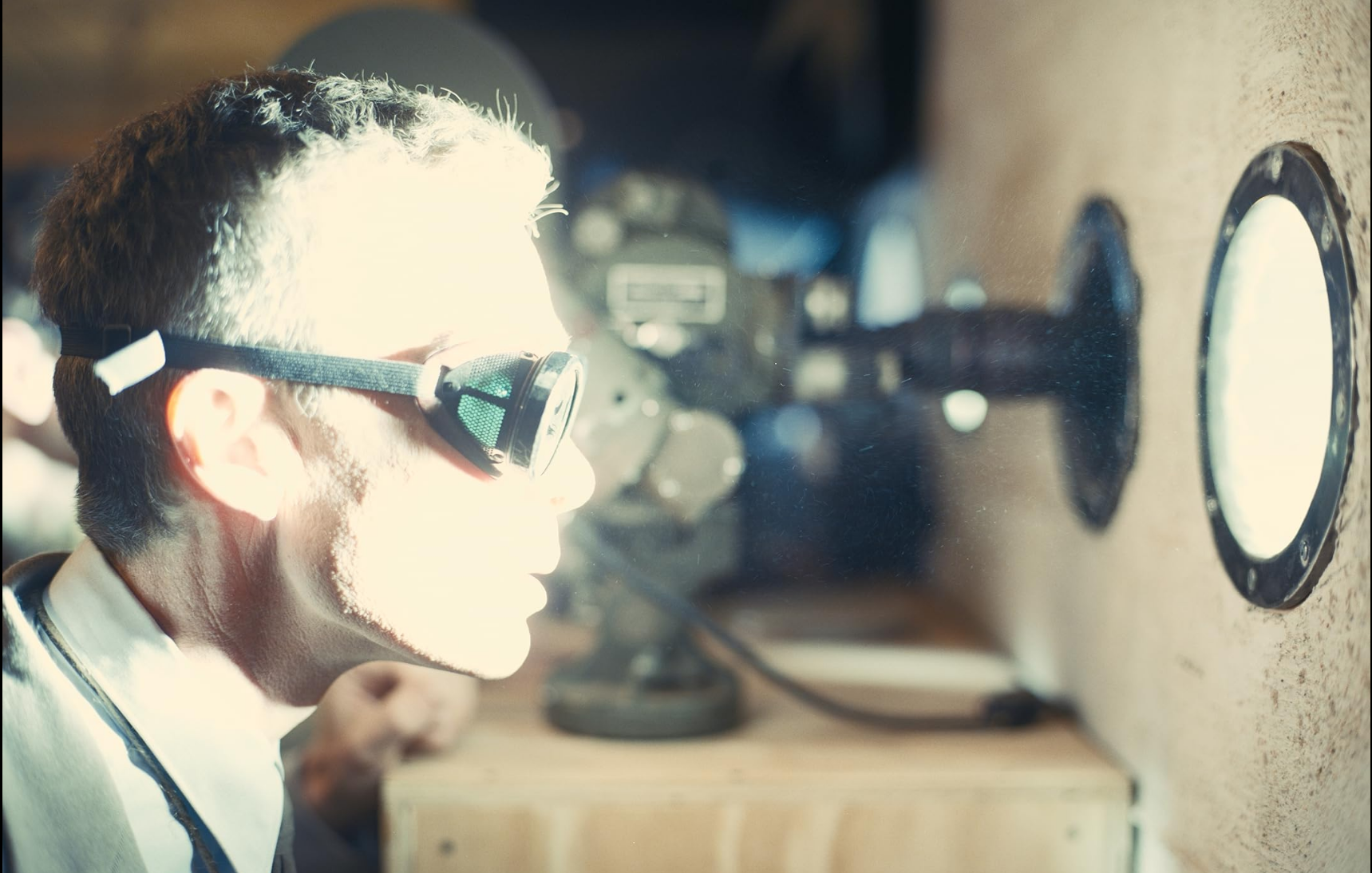
The question of the cinematic sublime is present in regular theatrical exhibition, but the IMAX factor aggressively charges the elements of transcendence and immanence of cinema. The sheer size of the screen, when paired with the imagery found in films like Nolan’s atomic explosions in Oppenheimer or Villeneuve’s brutalist, H.R. Giger-infused vision of the desert world Arrakis in Dune, creates a window into the realm of the sublime McBride speaks about. These films are also notable within the blockbuster canon as slightly more obtuse and artistically-driven productions, which have helped them resonate with audiences. The explosion of the Trinity Test in Oppenheimer is slow and deliberate, played in almost complete silence, indulging in slowness to inspire awe and terror through a display of atomic power.
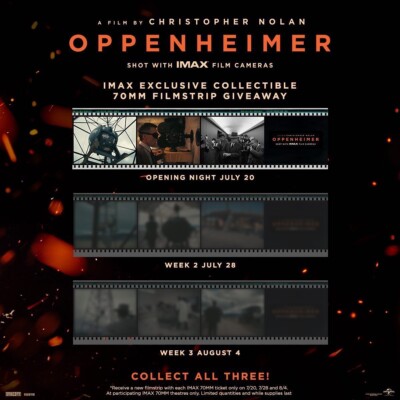
And it clearly translates to good business, as 20% of Dune: Part Two’s global box office take during release came from IMAX alone (IMAX Sets New Record for Global Market Share with "Dune: Part Two"). Ryan Coogler’s vampire film Sinners also enjoyed strong business from IMAX, with a similar take for the film’s global box office. All of these films also incentivized visits to IMAX 70mm shows by limited amounts of replica film strips from the films, pictured below.
Specialty-branded premium popcorn buckets have also become a popular piece of merchandise for new blockbusters. The earlier example of Dune can be visited again, as the bucket for Part Two was particularly controversial.
Even director Ari Aster, of Hereditary and Midsommar fame, attempted to tap into the IMAX market with his surrealist satire Beau is Afraid in 2023. An anomaly in the market that highlights the industry’s restrictiveness in their decision making, because as Weaver puts it, “...though the company is set to debut four more cameras, which will allow two IMAX shoots to occur concurrently, there's still a finite number of IMAX cameras — eight currently. That bottleneck combined with increased attention, he said, will start to impact the type of movies that get made at the highest level — and the types of directors that get to make them.”
Thus, the reliable strategy of “spend big to earn big” has returned, and it has sidelined smaller-scale productions to the independent release strategies that the internet and streaming provides: “By democratising individual interactive experiences, smartphones have inspired not only consumers but even professionals, such as Chan-wook and Chan-kyong Park (Night Fishing [Paranmanjang]), Sean Baker (Tangerine), and Jenna Bass (High Fantasy) to shoot films on smartphones or to make use of the aesthetic framework of mobile filming” (Szita, 44).
But it would be naïve to say that these films or the scenes they belong to have any kind of foothold in the mainstream conversation of cinema, or that the ability to create a filmic work with a smartphone has inspired a consistent body of New Wave, DIY filmmaking. Rather, the ease at which our culture disposes of things puts it in a very precarious position.
The Ossification of Culture (Conclusion)
Patti Smith, in her memoir Just Kids, describes the struggles of her life-long partner, photographer Robert Mapplethorpe, as being unable to delve into photography, which she believed would greatly enrich him, due to the costs associated with developing, printing, and the long times spent in the darkroom. In the book, Smith recounts their long financial struggles as committed artists in a fast-moving world. Later in the book, when Robert comes into possession of a Polaroid camera, she notes that “the immediacy of the process suited his temperament” (102). One immediately wonders what an artist like Mapplethorpe would’ve been able to accomplish with the immediacy and low-cost potentiality of the tools we can use to create art today.
It’s quite clear that the transition from film to digital photography carried with it a wave of fundamental changes to the filmmaking apparatus, and today, aspiring filmmakers can use the included suite of audio and video hardware and software included to create their own work. It’s a vision that Apple especially uses in order to sell their newer generations of iPhones, but one has to wonder, what has all of this technology resulted in for our cinema, in what is now a screen-first visual culture? If all these systems, interacting with each other are creating a profound cultural bifurcation between convenience and community?
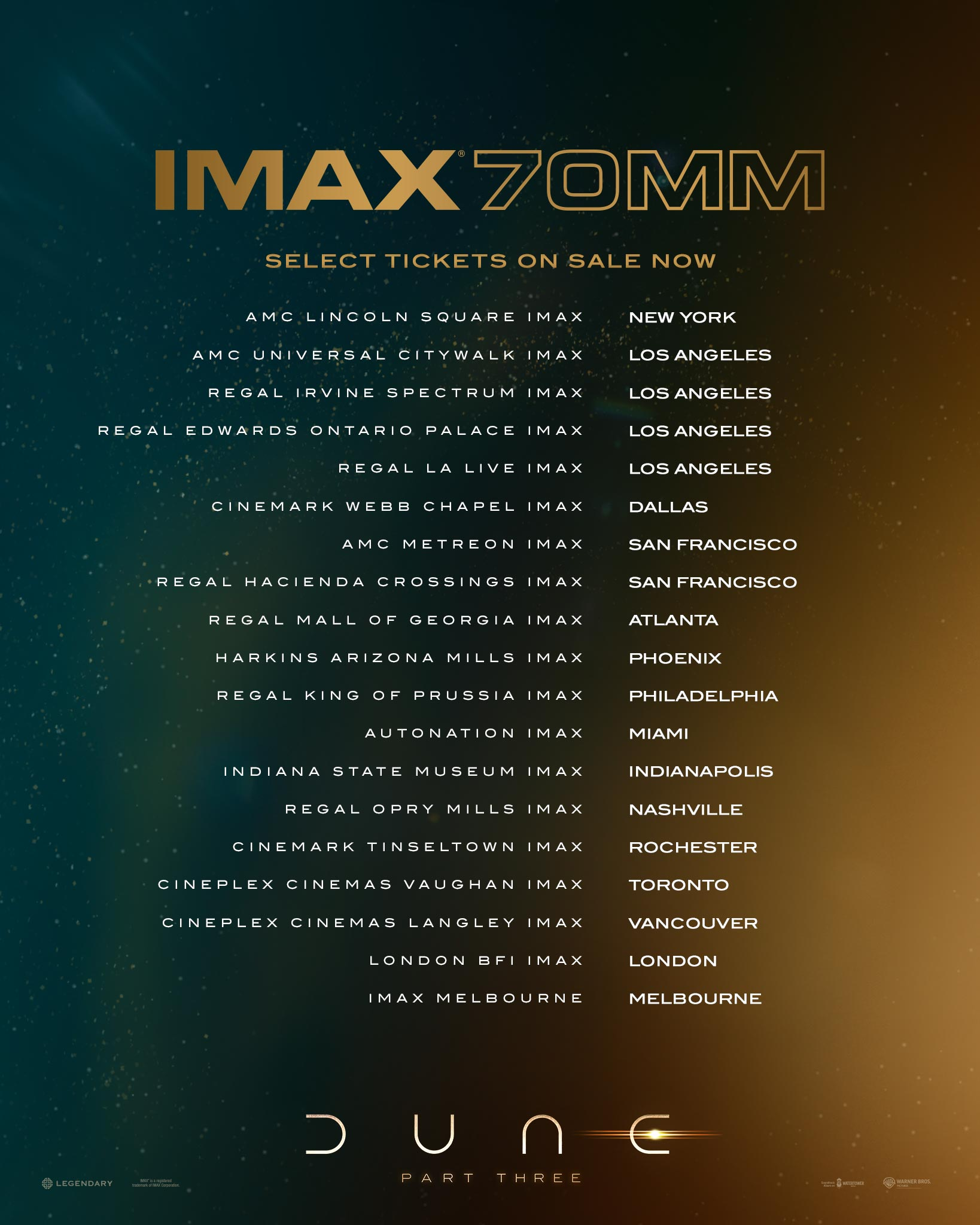
This bifurcation I speak of, is creating an environment where only the biggest movies get made, and the prevalence of internet subcultures makes it easier than ever to not have to learn about anything outside of one’s interests, creating a self-imposed ossification of culture unable to reconcile its differences. The popularity of IMAX 70mm spectacle has even resulted in Nolan’s upcoming Odyssey and Villeneuve’s Dune: Part Three to release their first rounds of tickets a full year and 8 months, respectively, in advance of release, starting a wave of hype far before the film sees any form of real advertising.
As for Dune, there will be 19 total showings around the world in IMAX 70mm, 15 in the United States alone, 2 in Canada (Toronto and Vancouver), one in the UK (London), and one in Australia (Melbourne). An already restrictive format setting an even more restrictive precedent is not encouraging for the future of the art form, leading movie theatres to feel like concert venues.
There’s arguably an increased air of “prestige” about it, but it hardly seems important when considering the future of theatrical exhibition in an increasingly expensive, isolated world. It is incredibly difficult to say where the film industry goes from here. The advent of AI poses yet another constantly changing technology being adopted by it, standing in stark contrast to the popularity of analog aesthetics and commodities.
If audiences have proven they’re more willing to spend money on a product, tangible or not, when it’s suffused with cultural meaning, it’s difficult to trust that the companies responsible for providing that culture will prioritize it idealistically over culture and art. That is just not the world we live in, but perhaps the appetite of audiences proves that this is a business worth sustaining, for their interests and ours.
Images in this online publication are either in the public domain or are being used under fair dealing for the purpose of research and are provided solely for the purposes of research, private study, or education.