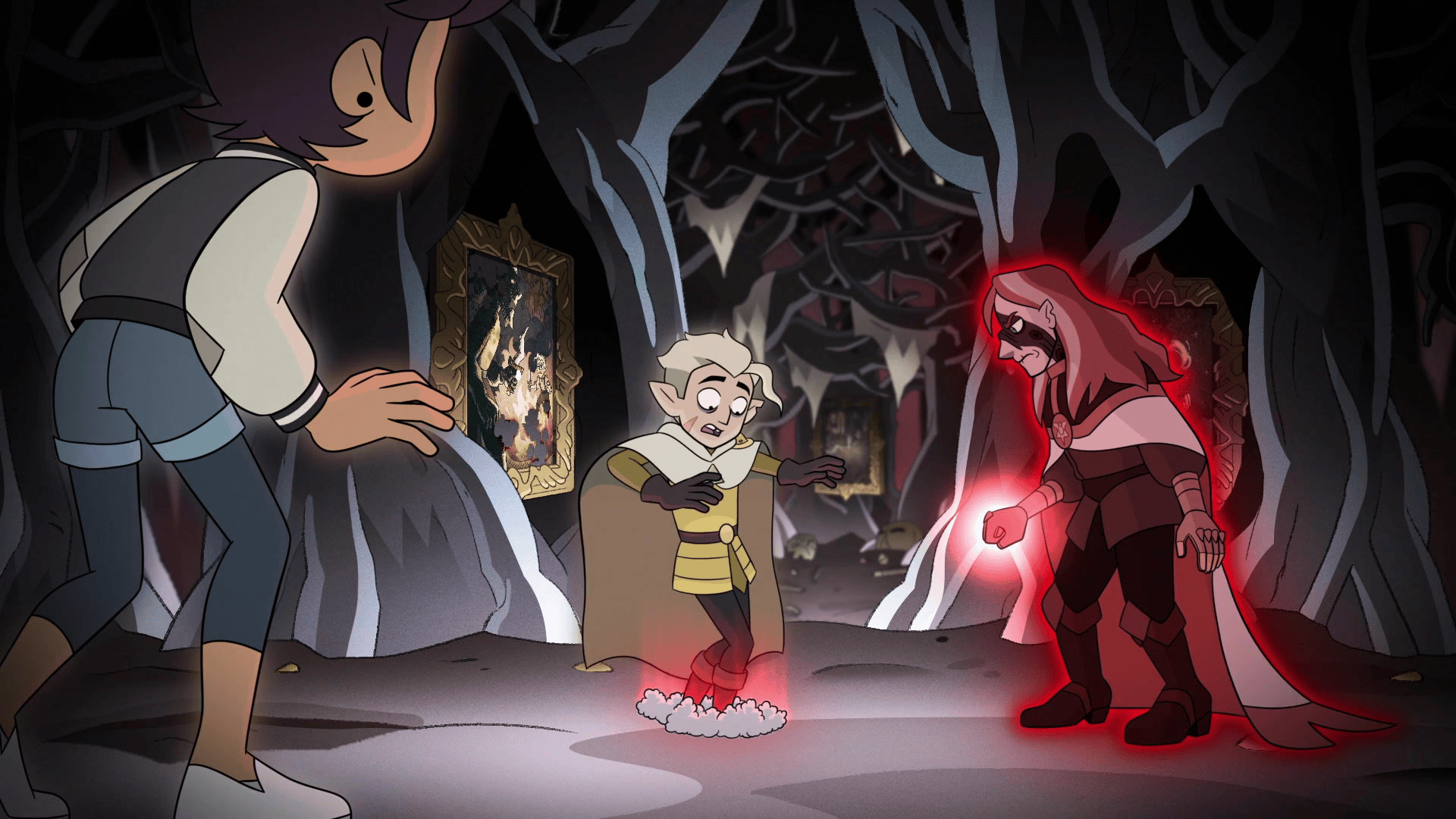
A Lying Witch and a Warden, The Owl House
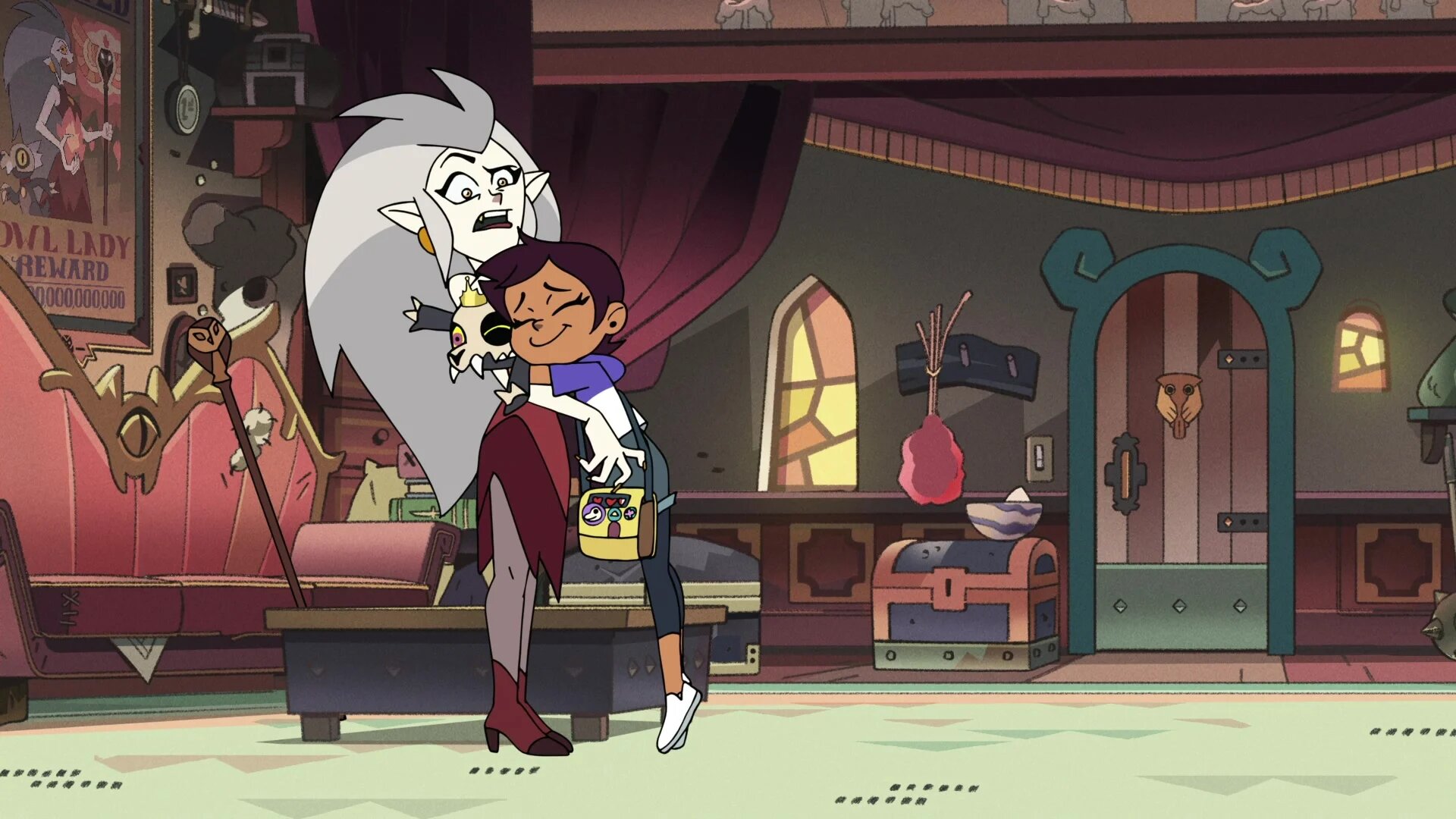
1 media/2351696_thumb.jpg 2026-04-14T02:33:57+00:00 Frederic Manguerra 1a34d7418c290386dbb4dc0628ee3b07d962206b 71 2 Screenshot from episode A Lying Witch and a Warden, The Owl House. Directed by Sandoval 2020. © Disney Luz hugging King and Eda after being allowed to stay at the Owl House. plain 2026-04-14T03:00:14+00:00 Frederic Manguerra 1a34d7418c290386dbb4dc0628ee3b07d962206bThis page is referenced by:
-
1
2026-04-08T19:24:13+00:00
Subverting Heteronormative Gender Expectations and the Deconstruction of Gender Performance in "The Owl House"
24
plain
2026-04-14T03:14:13+00:00
Introduction
"My biggest mistake was trying to protect you by changing this beautiful good witch into something she wasn't" (For the Future 41:40 - 41:48).
Gender representation in children’s animated media heavily favours male characters embodying “toxic masculinity.” Female characters are frequently underrepresented, and at times, demeaned. Studies of American children’s and teen television from 1974 to 2007 show a “2 to 1” or “3 to 1” imbalance in favour of male characters (Gerding and Signorielli).
The insight from this article’s initial quote embodies one of the messages that the Disney animated series The Owl House (TOH), created by Dana Terrace, conveys: it is okay to stand out and be different from those around you. The quote applies not only to the encouragement to embrace unorthodox behaviouralism but also to the show’s themes of radical inclusion and gender-binary nonconformity through the fantasy-adventure genre. These themes factor into the show’s fanbase growth, as although it was previously intended for younger audiences, it outreached teenagers and young adults for its female and queer representation and dismantling of societal gender normativity, which is uncommon for children’s shows.
This article will draw on the theoretical framework of the book Gender Trouble: Feminism and the Subversion of Identity by Judith Butler, whose proposition states that the subject of the feminine follows the hegemony of the “phallogocentric" construct of gender, and that there is no identity behind gender, only the “performance” of it. “There is no gender identity behind the expressions of gender; that identity is performatively constituted by the very 'expressions' that are said to be its results” (Butler 33). Gender itself is a Western social invention which confines persons under stereotypes unfounded except by the exclusion of viewpoints of the feminine and gender non-conforming persons.
A discussion of concrete examples from TOH will follow this article’s theoretical framework, analyzing the characters' personalities and the show’s cultural impact on queer youth and queer media.
This article argues that The Owl House subverts heteronormative gender roles through its characterization of female agency and deconstruction of the patriarchy and performance of gender, particularly relating to toxic masculine traits. Analysis of The Owl House under the radical feminist and queer theory literary lenses, based on the ideas posed by Judith Butler’s Gender Trouble: Feminism and the Subversion of Identity, reveals how the show motivates youth to question and dismantle social constructs of the performance of gender, ultimately advocating for inclusive understandings of individuality and further expansion of positive representation of female and queer peoples.Theoretical Framework - Gender as Performative and the Heteronormative
To understand this article’s theoretical framework under Butler’s Gender Trouble, it is important to define the differences between sex and gender. These two terms are often blurred in contemporary language, as they are “often used interchangeably, despite having different meanings” (Government of Canada). The Government of Canada (GoC) defines sex as referring to “a set of biological attributes”. At the same time, gender pertains to “socially constructed roles, behaviours, expressions and identities”, also acknowledging that gender acts as an influencer and “[distributor] of power / in society” (GoC). The GoC officially recognizes gender as a social construct that may directly impact how power is distributed based on a perceived, inherently performed, “identity.” Butler disagrees with this notion, stating that “[t]here is no gender identity behind the expressions of gender” when discussing the philosophy of Friedrich Nietzsche, as this “identity is performatively constituted” by the expressions themselves (33).
“[T]he various acts of gender create the idea of gender,” defines Butler’s view of gender as “created by its performance and hence [being] performative” (178; Morgenroth and Ryan 3). The upholding of this performative gender identity is rooted in the dominant male viewpoint. Masculinist values are pushed to younger demographics as they enforce the traditional, gender normative structures that Western society has placed to fit the social construct of the “gender binary”. Butler draws on the work of French philosopher Luce Irigaray to describe how English is “phallogocentric” and does “[excludes] the feminine altogether,” phallogocentric referring to the privilege and authority in the Western world that masculine viewpoints have over the feminine and writing (14). Butler assesses that the underrepresentation of women in Western media is due to the “many modalities of phallogocentric language” (15). It is under this critical lens that Butler finds the support of gender normativity to be limiting, violent, and policing.
Children’s media continues to be guilty of upholding gender normativity, with shows having majority-male main characters and females providing more supportive roles. Disney, the company under which TOH aired, has a history of portraying toxic masculine traits, resulting in the creation and production of characters that are “less emotional, less in control of their sexuality” (Harriger et al. 678). Regarding the dismantling of gender norms in TOH, although Gender Trouble mainly contemplates the subjectivity and role of women, Butler points out in the preface that “gender norms … establish what will and will not be intelligibly human,” which may apply to the condemnation and dismissal of emotionally expressive and queer men who do not fit the rigid definitions of masculinity as well as those who reject the idea of femininity relating to passivity (xxiii). This stigmatization is prevalent not only in the media we as a society consume, but it is also acknowledged to be present in research studies, restricting non-binary identities to the label of “‘other’ in addition to ‘male’ and ‘female’” (Morgenroth and Ryan 7).
TOH, by applying this experimental sociopsychological approach, actively challenges its audience to question these traditional gender norms, establishing that anyone can partake in certain conventional gender-binary-coded roles in any setting, no matter their identity.Female Agency and Rejection of Passive Femininity
The action-adventure genre of tween programming is typically “geared towards boys” with “action, violence, and [an] overall high activity level” being the main factors in the shows’ narratives (Gerding and Signorielli). The representation in children’s media of male characters being the main inhibitors to these main factors is unfounded in Butler’s Gender Trouble as “[g]ender ought not to be construed as a stable identity,” as gender is a social construction of identity “tenuously constituted in time… through a stylized repetition of acts” (179). It is under Butler’s theory of gender identity that TOH instead places female characters at the forefront of the show’s fantasy-adventure genre.
TOH’s main female characters, Luz Noceda and Edalyn Clawthorne (Eda for short), often defy provocations and opposition with strong, assertive moral convictions, traits traditionally coded as male. Luz and Eda both carry their own ambitions, with Luz making the decision to stay in the Boiling Isles to pursue her goal of becoming a witch in direct defiance to her mother’s authority and Eda being an antiauthoritarian outcast, being actively hunted by the show’s antagonist government, the Emperor’s Coven, for being afflicted with the Owl Curse by her sister and for practicing wild magic.
“Us weirdos have to stick together” is a show-defining quote from the first episode of the series by Eda that sets the tone for the series’ protagonists as Eda mentors Luz how to become a witch (A Lying Witch and a Warden, 14:17-14:19). The series’ first episode reinforces the “[advocation] for feminist ideals,” with Eda rejecting and defying the Warden Wrath’s romantic advances, subverting the damsel in distress trope (Fawcett 129). Their performances of resistance against societal expectations actively initiate events and move the narrative forward, disrupting the trope of women as being passive participants in moments of action.
Luz, upon learning that Emperor Belos, ruler of the Boiling Isles, is “a witch-hunter from her world,” fills herself with determination in protecting her friends and the other beings of the Boiling Isles (Dennin et al. 123).
The characters Luz, Eda, Willow, and Amity are placed as the show's primary female characters, “[challenging] standard … expectations of masculinity and femininity,” as they “frequently fight for their place and path” (Fawcett 129, 131). This is exemplified in the show’s depiction of character growth, with Luz advocating for change at the Hexside School of Magic and Demonics to allow students to study more than one track of magic, Eda protecting Luz and King, while at the same time evading the Emperor’s Coven, Willow wanting to be a student in the Plant track after her initial foisted placement into the Abomination track, and Amity rebelling against her mother’s authoritative parenting influences.
On the topic of rejecting femininity as defined by societal norms in children’s media, Butler writes, “there is no preexisting identity by which an act or attribute might be measured… [as] the postulation of a true gender identity would be revealed as a regulatory fiction” (180). Action and agency are not bound by the phallogocentric binary in the show, as Fawcett states that “power exists across many characters and spaces, without any kind of gendered separation” (Fawcett 129). Understanding this, the show observes Butler’s theory on the social construct of gender as Butler points out that “Gender is the repeated stylization of the body… within a highly rigid regulatory frame” (43).Deconstruction of Toxic Masculinity
Harriger et al. suggest that themes of “violence and inspires fear” are common toxic masculine traits that are “consistent with the conceptualization of toxic masculinity” portrayed in children’s animated movies, not otherwise noted in previous studies of children’s animated movies (679, 683). The show does feature moderate acts of violence through events such as magic battles and the dismemberment of body parts; however, most of the action is provoked by members of the “Emperor’s Coven” and those who support the restrictions imposed by the regime.
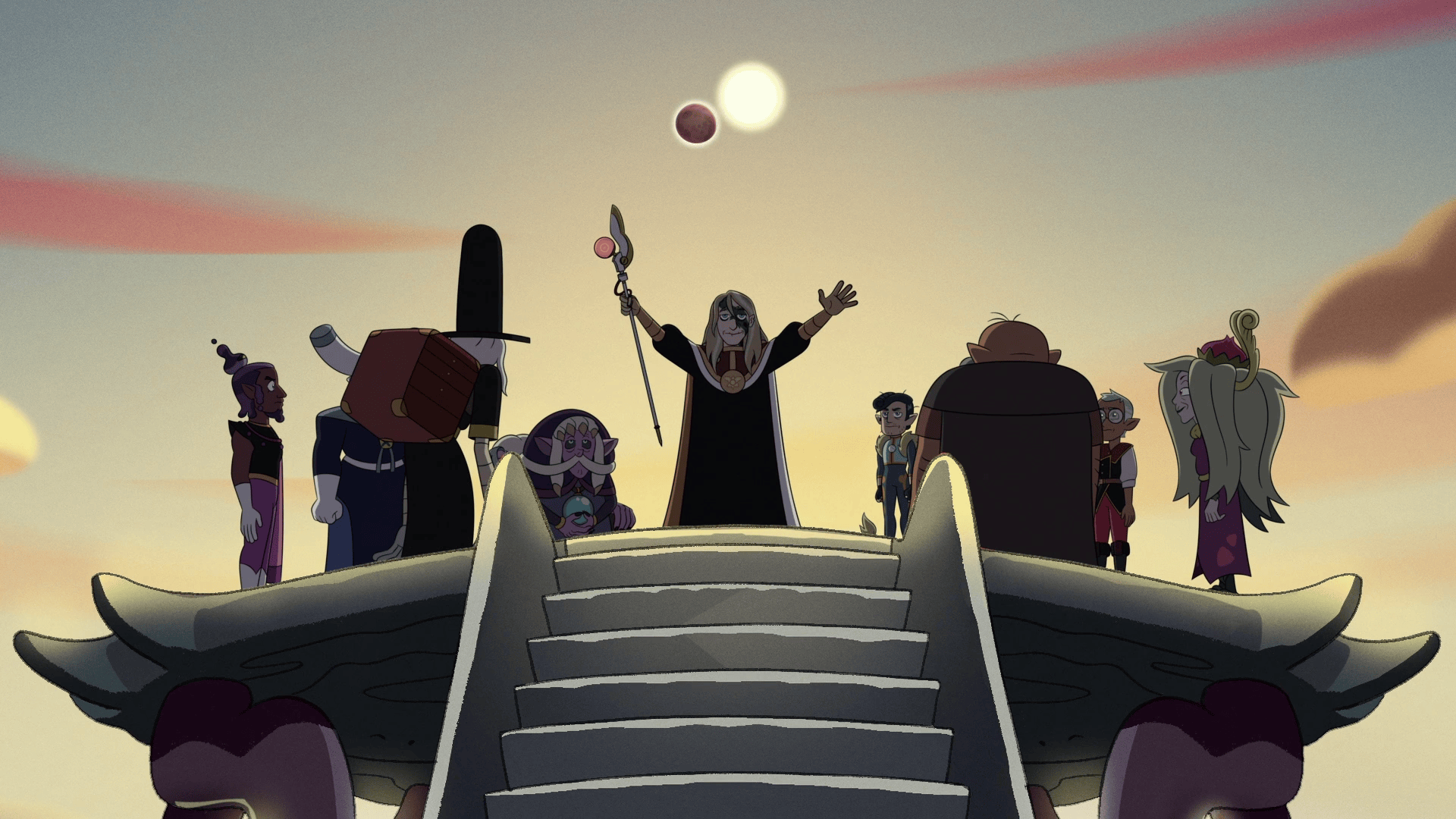
The demon world’s main antagonist, Emperor Belos, exhibits the toxic masculine traits of violence and inspiration of fear through his hidden doctrine of ridding the Boiling Isles of the Titans’ magic altogether, inciting the mass genocide of all magic and witches in the demon realm without directly informing his head coven members, the Coven Heads. Emperor Belos is written as a cisgender, White human male who inculcates a sense of morality in magic by banning the Boiling Isles’ glyph magic, a magic unique to titans passed down through their language, themselves, that only a few, Luz, Eda, and Emperor Belos himself, have learned. Belos is also responsible for endangering palismen, sentient magic trinkets that sit atop magic wands, by collecting their essence to gain power and to stop himself from turning into a monstrosity.
Belos’s regulatory practices and gain of power throughout the series fall under what Butler claims to be “compulsory heterosexuality”, mimicking the hierarchical “self-aggrandizing gesture of phallogocentrism” (18). Emperor Belos asserts his dominance over everyone and tries to prevent the intervention of Luz and her friends by sending members of the Emperor’s Coven to capture them in his mission to rid the Boiling Isles of magic. It is in the act of defiance of Emperor Belos’s rule by using magic to educate and positively influence the community that the toxic masculine trait of violence and domination is deconstructed.
The male protagonists of the show navigate Belos’s regime alongside the show's primary subjects of action, the female protagonists, thereby placing the show's framework within “the rejection of toxic and violent masculinity… [opening] space outside of patriarchal heteronormativity” (Fawcett 129). Male characters openly express emotion throughout the series, with King, Gus, and the Golden Guard, Hunter, experiencing moments of emotional growth through camaraderie with one another and the other female protagonists.
One of the most well-defined portrayals of positive masculinity is King Clawthorne, the last remaining titan of the demon realm, whom Eda adopts after finding him in an ancient cave. King initially performs an act of hypermasculinity, the exaggerated portrayal of masculine stereotypes, by asserting himself as the king of demons. Despite this, King keeps a collection of stuffed animals and other toys as his “subjects” and portrays them as being helpless in the face of actual danger. This bravado persists in parodying hypermasculinity, but as King gradually warms to Luz’s presence, it is revealed that he has a deep-seated need for affection and affirmation of his capabilities, not knowing what his purpose is or who his real parents are. Prior to uncovering the secrets of his true potential, King expresses fear of abandonment and loneliness, linked to his identity as an orphan, to Luz and Eda, whom he sees as his family.
He ultimately uses this experience of love and care to convert the ethereal being, the Collector, who is being taken advantage of by Emperor Belos, to put an end to his childlike mischief and treats the Collector with the same attentiveness Luz and Eda gave him, showing King’s emotional growth as the series concludes. “the Collector is just a little kid. A scary, powerful one, but… also… sad, and alone. I don’t know, this whole time, I was scared of making him mad, but… I think I can relate to him” (For the Future 39:32-39:44). This quote from the second last episode of the series shows King’s growth in emotional maturity after being treated like a child for most of the series. King handles the childlike and potentially cataclysmic behaviour of the Collector with respect and treats the Collector not as an entity that can be manipulated for his powers, but with the same nurture that Luz and Eda gave him in the past. King’s display of nurture towards the Collector on managing feelings of insecurity, loneliness and sadness speaks to how the show encourages the development of emotional intelligence rather than traits rooted in violence.
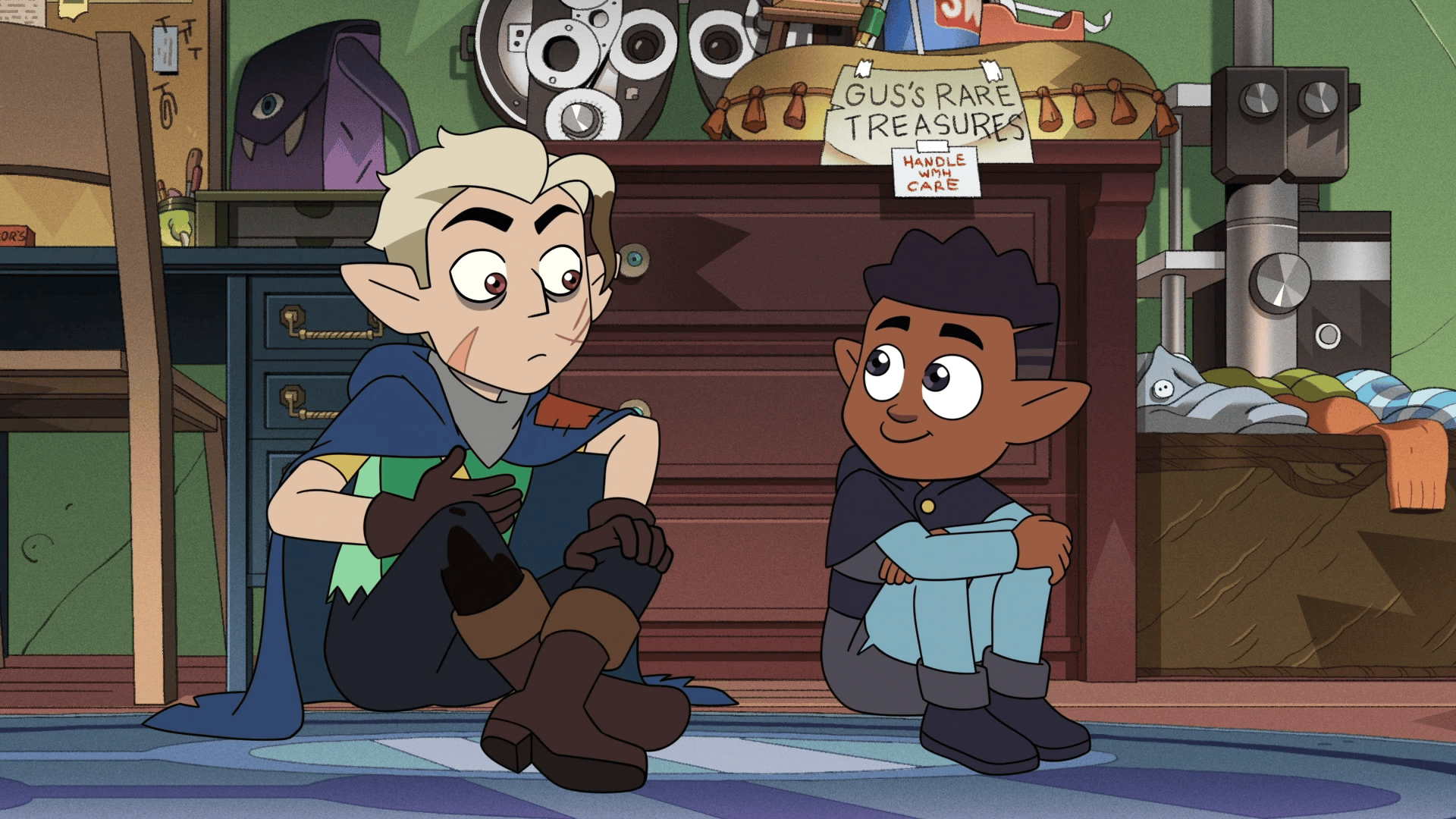
Augustus Porter (commonly referred to as Gus) is a supporting character in the series who also exemplifies positive masculinity by helping others develop emotional intelligence. Gus is defined mainly by his passion for illusion magic and his intrinsic desire to learn more about humans and human culture when he first meets Luz. Unlike stereotypical portrayals of male characters, Gus handles feelings of insecurity and anxiety through honest communication, as seen in how he navigates confrontations with friends and enemies without resorting to aggression, instead inviting open-ended conversations that address the main issue while remaining mindful and sensitive to the other characters’ feelings.
A prime example of this is in the episode “Labyrinth Runners,” where Gus helps Hunter (more on his character later) through a panic attack by teaching him a breathing technique that calms him, after previously being saved himself. Despite Hunter being antagonistic towards him and his friend Luz, Gus understands what Hunter is going through because of a prior event in which Gus also had a panic attack and was saved by the breathing technique he learned from Willow. Gus demonstrates the advantage of reaching an agreement on peaceful terms over violence as Hunter grows to trust him, proving that non-hostile conflict resolution among parties nurtures positive masculinity.
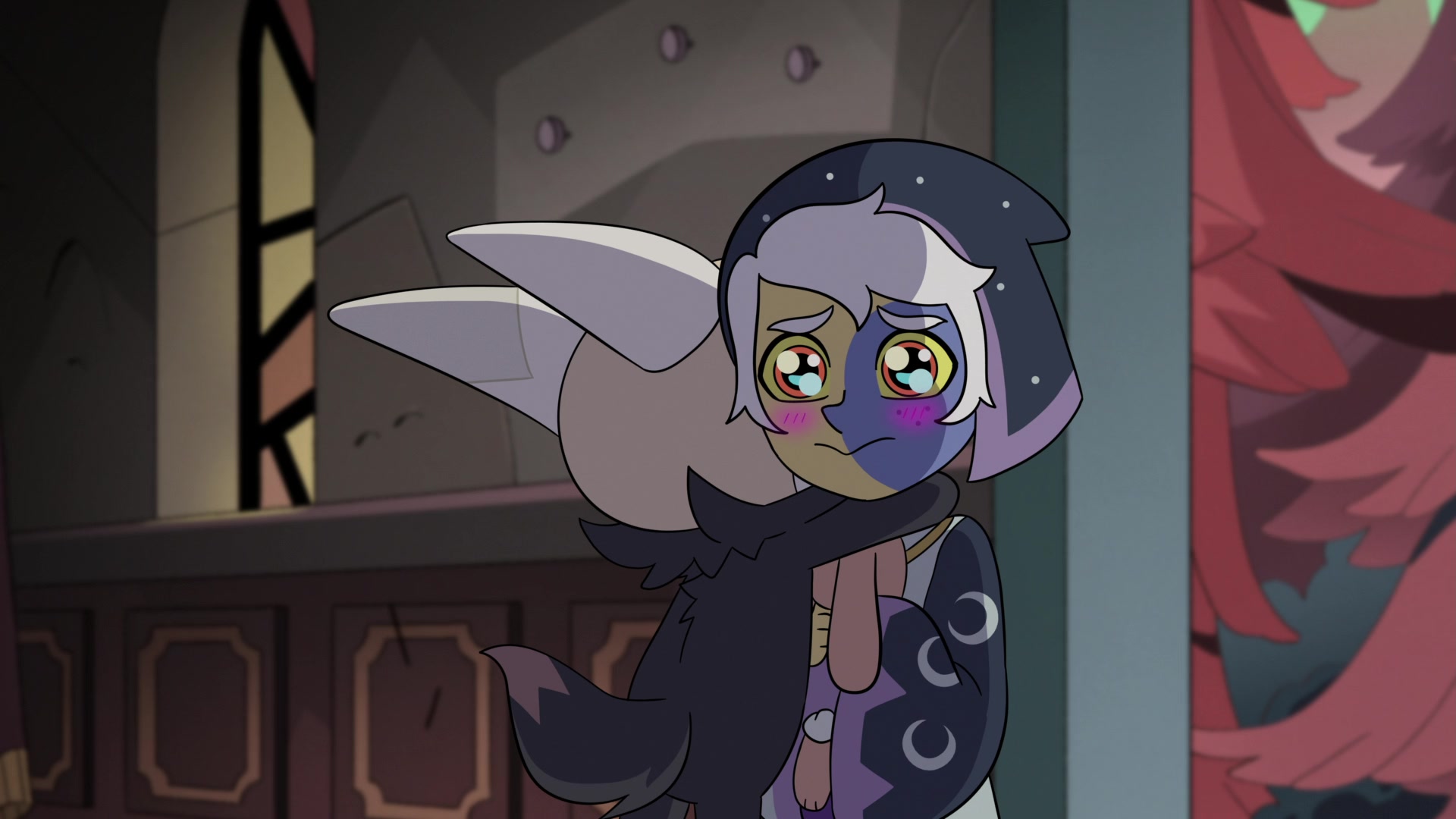
Hunter’s growing trust in Luz’s cause in protesting Belos’s eventually converts him from his initial antagonist role, as the new head of the Emperor’s Coven, and from being deceived by Belos, who told him they were related (uncle and nephew). Much of Hunter’s character growth lies in his conversion against the Emperor’s Coven and Belos after learning about his real identity as a “grimwalker,” a magical manifestation made in the image of Belos’s deceased brother, Caleb, and of Belos’s true intentions of eradicating all life on the Boiling Isles. Hunter experiences moments of anxiety and grief as he questions his own ethics, realizing he is a byproduct of magic and, by supporting Belos, actively participating in the culling of all magic.
Displays of emotional vulnerability are uncommon in heterosexual men, as they follow the traditional norms of masculinity. In a quantitative study on the reinforcement of “[t]raditional masculinity norms, which emphasize emotional restraint, dominance, and heterosexuality,” heterosexual men adhere more to the hegemonic definition of masculinity in comparison to homosexual men (Borinca and Gkinopoulos, 1). TOH creates a narrative unreliant on the “anti-femininity mandate” of phallocentrism commonly portrayed in cartoons for children and young adults, specifically male viewers, instead countering the “femininity stigma” by allowing its male characters to show emotional vulnerability (Borinca and Gkinopoulos, 3).Non-Gender Bound Identities and the Normalizing of Queerness
Dana Terrace’s TOH does not shy away from the portrayal of “positive, explicit, queer representation” in an aired children’s animated television series, made possible by the environments the characters inhabit, which are “strange, weird and wondrous” (Dennin et al. 128). The show in itself is “the celebration of personalities and identities”, focusing on what makes each character special without being “bound up in traditional gender roles” (Fawcett 129).
The world-building of TOH reimagines an environment in which “queer identities can thrive and hetero/homonormativity does not exist” (Dennin et al. 123). On this topic, Butler states that “[t]he limits of the discursive analysis of gender presuppose and prefigure the possibilities of imaginable and realizable gender configurations,” suggesting that shows like TOH expand the imaginative possibilities for how a culture without today’s international heteronormative society could be (13). TOH defies heteronormative sex roles by avoiding focusing on targeted gender demographics and instead becoming a safe haven for the queer community through its representation of bi, lesbian, and non-binary characters. Christina Fawcett comments on TOH, stating that“[t]he incorporation of characters outside heterosexual or heteronormative structures without comment points to their normalcy” (130). The creation and identity of Disney’s “first ever explicitly non-binary character”, Raine Whispers, voiced by non-binary voice actor Avi Roque, and the brief introduction of Willow’s dads being gay are not commented on explicitly because gender identity and sexual orientation do not have to be questioned about in the world of TOH (Chilton).
Raine, despite being shorter than strong female witches like Eda or Lilith, is a competent leader who demonstrates bravery in their cunning strategies to fight against the Emperor’s Coven. Raine's non-binary identity is never commented on in the show because, according to Dennin et al., “[q]ueerness is just one aspect of these multifaceted characters” and is thus unimportant to the actual capabilities displayed by Raine in the story’s plot (124). The need to fulfill gendered notions of action is unnecessary as “[gender] identity is performatively constituted” (Butler 33).
Anca Gheaus argues on the topic of transexuality and gender theory that even the identities of “‘non-binary’ and ‘gender queer’ … are gender identities … best understood as the absence of a gender identity” (32). The term “gender nonconformity” is highly debated on whether or not the idea of identities such as non-binary, gender queer, and agender actually legitimize the concept of gender identity, and, thus, gender norms. TOH challenges this viewpoint on gender in the representation of same-sex marriage and the introduction of Raine Whispers, a non-binary character.Cultural Significance and What the Show’s Cancellation Means for Queer Communities
TOH aligns with several other contemporary young adult cartoons that feature queer representation in their characters and world-building. One paper on queer figured worlds notes the accomplishment of two other critically acclaimed animated television series, She-Ra and the Princesses of Power (SPOP) and Kipo and the Age of Wonderbeasts (KAW), in being “queer imaginaries or queer figured worlds that challenge… heteronormativity” (120).
TOH’s run was cut short by Disney in 2021, narrowing the series to just three seasons, with its final episode airing on April 8th, 2023. Dana Terrace stated the reason for the show’s cancellation in a Reddit post on the show’s subreddit, noting that “[the show’s] audience skews older” and is targeted toward tween and young adolescents rather than the company’s usual younger audiences (Terrace, Dana [AntagonistDana]).
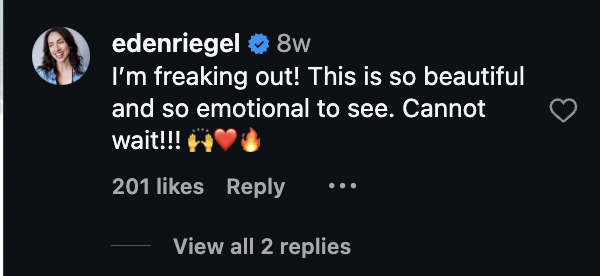
There were no new updates on the possibility of adapting TOH until February 12, 2026. Terrace posted on her official Instagram account that a new graphic-novel adaptation titled The Owl House: The Long-Lived King was in development and expected to be released on September 29, 2026. Fans and people formerly involved in the show have taken to the comments on Terrace’s post to celebrate this news, with Eden Riegel, a former voice actress for the supporting character Boscha, commenting, “I’m freaking out! This is so beautiful and so emotional to see. Cannot wait!!!” (Riegel, Eden [@edenriegel]).Constructing a New Paradigm of Gender Representation (Conclusion)
“The very thinking of what is possible in gendered life is foreclosed by certain habitual and violent presumptions” (Butler viii). Children’s media consumption often shapes how they address and view the world around them, with some men growing up and continuing to adhere to ideas of heteronormativity. This way of thinking creates barriers to open-minded conversations about identity, as the phallogocentric ideology restricts what attitudes men and women can adopt, again entrapping society in the gender binary.
The common narrative behind gendered representations of male and female characters consists of male characters displaying traits of toxic masculinity, and female characters are often depicted as passive. TOH subverts the hegemonic structure of the action genre in the representation of strong female leads and the dismantling of the femininity stigma. Looking back, Judith Butler states that these “expressions of gender” do not constitute gender identity, but are the result of “that identity is performatively constituted” (33). Gender is a social construct which insists upon itself, rooted in the phallogocentric structure that we continue to live in today, a structure not often contested in television programming targeting younger audiences.
Children’s media is a site of socialization, often riddled with messages on how to behave in society. TOH contributes to this site of socialization by shifting expectations of how characters are supposed to behave based on their identity. TOH is a celebration of identities, particularly in validating queerness and inviting the youth to challenge their own destinies bound by gender conformity. TOH goes against the idea of normalcy, encouraging its viewers to express themselves regardless of what society expects of them.
Despite TOH being cancelled several years ago, it now has an adaptation that is soon to be released. If shows like TOH that can garner a massive audience for representing the subversion of gender norms can be cancelled for not fitting a heteronormative brand identity, then there is still much more work to be done on the dismantling of phallogocentrism in children’s media.
Statement of Fair Use
Images in this online publication are either in the public domain or are being used under fair dealing for the purpose of research and are provided solely for the purposes of research, private study, or education.