THE INTERPLAY OF ASTROPHYSICS & EMOTION IN INTERSTELLAR
Ultimately, the 2014 film Interstellar, directed by Christoper Nolan is a captivating example of how contemporary cinema merges scientific exploration with emotional storytelling. It is a film that is known for its driven yet realistic portrayal of space exploration as the film integrates complex astrophysical concepts such as black holes, wormholes and time dilation as an immersive narrative that is grounded in human experience. A scientific and visually appealing product that draws on theoretical work of physicist Kip Thorne and the foundational principles (theory of general relativity) of Albert Einstein, Interstellar offers scientific ideas not as background elements but as critical components of its narrative and visual design. This essay will propose the research question of: How does Interstellar use vivid imagery, sound and cinematic techniques to represent scientific concepts while simultaneously exploring emotional themes of human connection? While the film offers distinctive images of the black hole Gargantua and the extreme environment of Miller’s planet it also serves as a key foundation in which scientific realism and cinematic imagination intersect. These patterns do more than illuminate abstract theories as they shape audience perception by demonstrating complex physics into sensory experiences, therefore making the intricate and complex both visible and emotionally vibrant. Through this duality, Interstellar exemplifies how science fiction cinema can operate as a form of visual culture that extends scientific knowledge while also highlighting meaning through affect and narrative.
Considering the analysis focuses on the intellectual context of film studies and visual culture this paper also draws on perspectives that consider cinema as a capable form of producing knowledge and shaping perception. Science fiction recognizes a genre that connects and explores the relationship between scientific discourse whether it is real or fake, imagination, and its impact on people and societies, through engagement with both scholarly and non-scholarly arguments on science fiction cinema, representations of science and film theory, this essay will explore a framework that combines a perspective on visual analysis with attention to sound design, editing and cinematography. In doing so, it explores how cinema as a medium contributes to the discussion of both scientific ideas and emotional experiences. Essentially, this essay will focus on four themes and explore each one through a creative perspective. First, it will examine the film's visual representation of astrophysics, focusing on how imagery such as Gargantua and the wormhole reflects and adapts scientific theories. Second, it will consider the role of sound and music as part of cinematic techniques that shape the viewer's emotional engagement, particularly in relation to the film's themes of time and loss. Third, it will analyze particularly cinematic techniques including editing that structures the film's narrative and guide audience interpretation and opinion. Finally, the essay will explore how these combined elements contribute to a comprehensive outlook on human connection, ultimately suggesting that Interstellar uses science to not only imagine the future, but to reflect on the significance of relationships in the present.
Astrophysical's Through Imagery: Gargantua & Millers Planet
What is detailed and striking about Interstellar is its ability to transform complex astrophysical theories into visually coherent and emotionally engaging imagery. Rather than presenting a case of complex science as inaccessible, the film renders it tangible through carefully constructed and realistic visual sequences that draw from theoretical physics and theorists. In particular, the depiction of the black hole Gargantua and the harsh environment of Miller’s planet serve as central examples of how cinematic imagery can translate scientific knowledge into a form that makes it easier to absorb and still holds power. These visuals are not only situated within the work of Kip Thorne and Albert Einstein, but are also shaped by cinematic techniques that guide audience perception and interpretation. Considering this, Einstein formed a perspective titled “Theory of Relativity” which was published in article in 1905 in the German Journal, Annalen der Physik under the title “Zur Elektrodynamik bewegter Körper” (on the electrodynamics of moving bodies). In this article, he states, “So we see that we cannot attach any absolute signification to the concept of simultaneity, but that two events which, viewed from a system of co-ordinates, are simultaneous, can no longer be looked upon as simultaneous events when envisaged from a system which is in motion relatively to that system” (Einstein 5). He argues that time is not absolute but relative which raises the issue of simultaneity, which is the state of two or more events happening at the same time, when considering events across time and space. Light takes a small though finite amount of time to travel from an event to an observer, any event is inevitably perceived slightly after it occurs rather than at the exact moment it happens. The representation of Gargantua stands as one of the film's most significant achievements in visualizing science. Unlike other cinematic portrayals of black holes which are simplified, speculative imagery or unrealistic, Interstellar presents the idea of a black hole with a level of visual accuracy derived from advanced scientific modeling and insights from physicists like Kip Thorne. The black is depicted as a bright disk that appears with a sharp ring, similar to the planet Saturn; this ring or halo that acts as both above and below its horizon is a visual effect resulting from gravitational lensing, a phenomenon predicted by Einstein’s general theory of relativity.
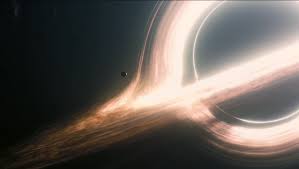
Gravitational lensing, according to NASA follows this, “Gravitational lensing occurs when a massive object — such as a galaxy cluster — warps space and time causing light to bend, distort, and magnify as it passes around the massive object” (Gianopoulos & Logreira 2025). This bending of light around a massive object is not explained through dialogue but is instead embedded directly into the visual experience of the viewer. The creation of Gargantua was so accurate it led to advancements in simulations for gravitational lensing and accretion disks. As a result, the audience does not stop at learning about scientific concepts but also perceive it. This approach reflects the key strength of cinema as the foundation for its capacity to communicate complex scientific ideas through sensory imagery rather than an abstract explanation. The image of Gargantua focuses on more than just a scientific level as well, it is vast and evokes a scale of awe and insignificance just by the sheer size of it, which reinforces the film's broader thematic concern with humanity’s place in the universe. The visual creation of the black hole is dark yet bright and alluring, it is powerful and surrounded by distorted light which creates an atmosphere of both danger and curiosity making it seem almost unrealistic but also aligning scientific accuracy with emotional resonance. Through this approach, the film establishes how visual realism can only advance rather than limit narrative meaning. The scientific credibility of Gargantua also supports the characters journey, making their presence to a surreal experience feel believable.
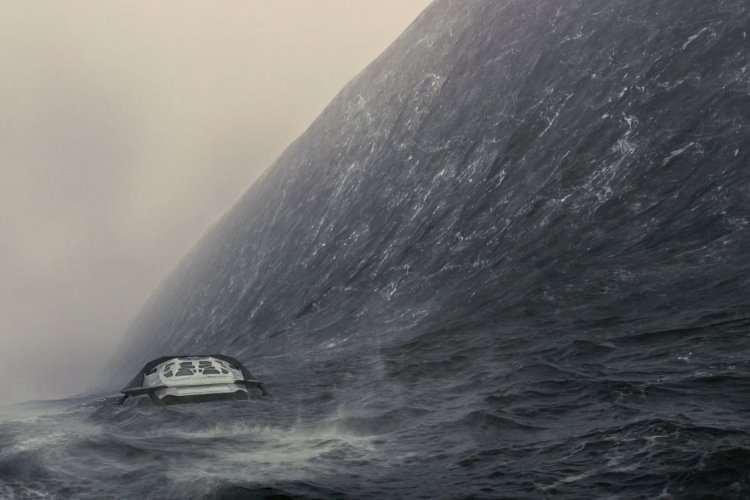
A similar focus between scientific theory and cinematic imagery can be closely looked at in the depiction of Miller’s planet. Miller’s planet is set as a course for a potential habitable place out of two other planets. Its placement is close to Gargantua and the environment is mainly a water world; because the planet is so close to Gargantua, time is altered here and is subjected to extreme time dilation, another concept derived from relativity. On Miller’s planet, one hour corresponds to seven years on earth; this is communicated through not only an explanation but also through the visual structure of the scene itself. Manor Bouazza explored in, “A Journey through “Interstellar” and Einstein’s Theory” the idea of time dilation and how it works, she states, “Time dilation is the result of two aspects of Einstein’s theory of relativity: general relativity and special relativity. General relativity deals with gravity, while special relativity deals with motion” (Bouazza 2023). Conclusively, gravity is understood not simply as a force but as a curvature of space and time itself. The greater the mass of an object, the more it distorts the surrounding spacetime. Therefore, time passes more slowly in regions with strong gravitational influence, such as near a planet or black hole, compared to areas farther away. In addition to this, motion also plays a critical role within Albert Einstein’s theory of relativity. Within the framework of special relativity, nothing can exceed the speed of light in a vacuum. As an object moves closer this limit its mass effectively increases while its length contracts. At the same time, time for that object slows down in comparison to an observer who is stationary or moving at a lower speed. Following this, the environment of Miller’s planet is filled with a vast and shallow ocean and towering waves that move with slow and uncertain rhythm, the waves are not only environmental hazards but also visual markers of the planet’s gravitational conditions as well. The cinematic portrayal of Miller’s planet emphasizes duration, scale, and tension which allows the audience to experience time as something now dangerous and uncertain. This particular scene of the characters visiting Miller’s planet happens fast but still has minimal dialogue and gradual build up of the immense danger that is going to occur, meanwhile, on planet earth seven years have already passed. When combined with the knowledge of time dilation, these visual choices become intense and carefully chosen to further the emotional stakes of the sequence. The delay in time experienced by the characters is not abstract and it becomes visible and immediate, particularly when the consequences await them upon their return. Through this perspective, the film uses imagery not only to represent scientific concepts but to iterate them into the emotional structure of the narrative.
Ultimately, these visualizations also shape how audiences understand and engage with scientific ideas. By presenting realistic concepts such as gravitational lensing and time dilation through creative imagery, Interstellar connects the gap between particular scientific knowledge and popular understanding. The film does not require viewers to fully understand the scientific or mathematical foundations of relativity, instead it offers a gentle and non complex visual representation in which these ideas can be collectively experienced. Broader discussions in visual culture suggest images play a crucial role in production and dissecting of knowledge, therefore, in the context of science fiction cinema, such images do not stop at illustrating science but also participating in defining its meaning. The emphasis on visual realism contributes to the overall credibility of scientific notions. The theories that are used are evident in its realistic approach and are used throughout the creative process of both Gargantua and Miller’s planet. The idea of authenticity allows exploration of the emotional impact the narrative has on the audience as the challenges faced by the characters are grounded in a world that feels consistent and believable. The integration of scientifically informed images with advanced storytelling allows Interstellar to scratch different surface levels like: an exploration of space, visualization of complex theories, and a narrative about human endurance and connection. By exploring astrophysics through imagery in Intersellar, it becomes clear that the film's imagery operates as a crucial link between science and emotion. Through the development of Gargantua and Miller’s planet, the film is able to transform theoretical approaches into lived experiences, allowing the audience to understand and engage emotionally with the characters. These images illustrate how cinema can serve as a strong foundation for visualizing the unseen, making it tangible while also deepening the narrative’s thematic resonance.
Sound, Music and Emotion: Hans Zimmer
The second and major theme through which Interstellar communicates both scientific ideas and emotional depth is sound design and musical composition. While visual imagery renders astrophysics perceptible, sound functions as another powerful tool for shaping how these concepts are experienced by the audience. Through the work of composer Hans Zimmer and the film's detailed sound design, the narrative translates scientific concepts like time dilation into an auditory and emotional experience. Diego Delfino, music composer and producer, analyzed and reviewed Hans Zimmer’s score for Interstellar, he stated, “My take on the film Interstellar is that it is a film about the vastness of space as much as it is about the minimal space that humans occupy in it, and their inability to fully comprehend what is out there including human emotions” (Delfino 2015). In this sense, sound does not accompany the image but also shapes the viewer's perception of time, space and human vulnerability. A striking aspect of the composition is its emphasis on organ musical based touches, which creates a sense of both scale and intimacy, traditionally, the organ can be associated within religious or transcendental settings, however, Interstellar is one of those transcendental settings as they are quite literally jumping and shifting the barriers of time. It contributes to the film's tone of cosmic awe and existential reflection but is also not theatrical in its creation. The score does not reflect the vastness of space and most films tend to carry soundtracks that reflect each scene perfectly, Hans Zimmer however went the opposite direction and instead created a melody that was simple and overlapped the same notes over and over again. Yet somehow, this happened to be the most reflective, personal and accurate portrayal of science and emotional experience. The musical pacing connects to the film's time depiction and reinforces the idea that time is not uniform but variable and uncertain. In moments where characters confront extreme gravitational environments or emotional separation, the score expands or contracts in intensity, subtly reflecting the instability of experience. Sound creation also plays a critical role in grounding the film's scientific realism and unlike science fiction films that exaggerate or “aestheticize” space and an active environment, Interstellar offers a more restrained and realistic approach, particularly in space sequences where sound is minimal or absent. The choice to indulge in this reflects scientific accuracy as sound cannot travel through the vacuum of space, therefore, this results in silence becoming meaningful in itself which emphasizes isolation and the fragility of human presence in space. Simultaneously, the contrast between silence in space and the dense soundscapes of planetary environments heightens the audience's awareness of spatial transition, making movement between environments emotionally and sensibly available. Journalist Lucy Hicks Beach states in her report, “What came to Zimmer was an intimate piano theme inspired by his son. Without knowing Interstellar was a film about space, time, and black holes, he composed a delicate piece about love, parenthood, and connection” (Hicks 2025). Moreover, the emotional core of the film is deeply tied to its design. The recurring musical themes associated with family, particularly, the main character Cooper and his daughter, establish an emotional continuity that surpasses vast distances and time gaps; these concepts consist of a melody that reinforces the idea that human connection can transcend physical separation. Through this, sound not only represents scientific concepts but also challenges them by recognizing these emotions in the face of time disruption. The Interstellar score is a simple one yet the sound has become a bridge between "invisible science” of space and human experience, which reinforces the film's broader aim of uniting scientific imagination with emotional storytelling.
Cinematic Techniques & Narratives
Beyond its visual and auditor appeal, Interstellar constructs meaning through a range of cinematic techniques that shape both narrative and audience perception. Essentially, the adaptation of cinematography, editing, and mise en scene work together to organize Interstellar in a complex story line that dabbles between scientific concepts and emotional storytelling. These factors guide viewers through environments, shifting narratives, and abstract ideas like relativity and multidimensional space that are meant to be experienced within a cinematic framework, therefore, technique itself becomes a form of storytelling and allows these connections between representation of science and emotional engagement to happen. Faryal Jogezai in “Film Theory,” highlighted major theoretical perspectives including cognitive theory and formalist film theory that connect back to the interplay of Interstellar, she writes, “Film theory is not about film critic or film history but much rather about the making
of films, its effects on the society and its status among the art forms” (Jogezai 2020). These frameworks are useful for understanding film in general as they offer critical tools for understanding how cinematic techniques and narrative structures work together to shape audience perception and emotional response. The film emphasizes scale and contrast to situate human figures within vase and overwhelming environments and it is shown throughout the film when the characters are venturing into Gargantua and on Miller's planet. The use of wide shots and expansive framing underscores how insignificant each individual character is against the backdrop of space, while close ups are reserved for moments of emotional intensity, particularly within familial relationships. The camera is also shot in a way where the audience is able to see detail and precision, it adopts a restrained and observational perspective and avoids jagged movement in favour of steady and intentional compositions that mirror the control associated with scientific inquiry. At the same time, moments of distress, instability, and turbulence during space travel or landings introduce accurate handheld camera work which reinforces the unpredictability certain environments have.
Editing plays a crucial role in structuring the film's complexity and it is about keeping what is needed in order for the film to produce its absolute best. Cross cutting between different locations and timelines allows the narrative to balance events occurring under different temporal conditions, particularly in sequences affected by time dilation. Considering this, Vivian Soback is an American film critic and media theorist, she highlighted in the November-December 2014 issue, “Nolan also uses parallel editing between Murphy on Earth and Cooper in space to compound this temporal disparity, which becomes even greater when the crew reaches its destination and begins exploration of two potentially habitable planets” (Sobchack 2014). It is understood by others that intentional editing like this highlights the cruelty of time, making the consequences of light travel emotionally tangible and Nolan presented time as a fragment instead of linear and continuous which encouraged viewers to actively piece together the narrative. This approach aligns with broader principles of film theory that understand editing as a means of constructing value and not just connecting scenes but shaping how events are perceived and understood. The film's use of mise en scene only furthered its praise as the environments were carefully designed to reflect scientific credibility and also emotional tone. The audience can see this through the stark minimal interior of the spacecraft called Endurance paired with the organic and dust flipped landscapes of earth which visually distinguish technological survival and environmental decay. These spaces were not just backdrops but also functioned as expressive elements that contributed to the narrative's exploration of humanity’s future. One of the most notable examples of cinematic technique shaping that occur in the film is the depiction of the tesseract, defined as a multidimensional space that visualizes time as physical dimension and shows past moments multiple times. Through innovative editing and spatial composition, this scene allows the protagonist Cooper to interact with different moments in time simultaneously but still unable to change through physical touch, only gravity. The repetition of visual patterns and colour scheme combined with shifting perspective creates a sense of both disorientation and coherence which Nolan reflects in the complexity of science. These techniques do not operate alone but are deeply interconnected to allow the viewers to shape the narrative and create emotional response. By coordinating these elements, Interstellar ensures that its scientific concepts remain accessible between intellectual understanding and emotional experience by allowing the audience to engage with both. In doing so, the film reinforces the notion that cinema is not simply a medium for depicting reality, but a power tool for shaping how reality can be imagined and understood.
Human Connection and Emotional Meaning in Interstellar
While Interstellar is widely recognized for its scientific ambition and technical predictions, the most impact lies in its exploration of human connection. Beneath its depictions of black holes, distant planets and relativistic time, the film constructs a deeply emotional narrative centred on love, family and survival. These themes, however, are not separate from the scientific elements the film produces but rather intertwined with them, suggesting that emotional experience is essential to how scientific concepts are understood and given meaning. Through its narrative structure and character complexities, Interstellar positions human connection as a foundation that both motivates exploration and transcend the physical limits imposed by space and time. This is evident in the relationship between Cooper and his daughter Murph, which serves as the emotional anchor for the narrative and the reason as to why Cooper enlists in this journey to find a habitable planet light years away. The bond is established early into the film through intimate and grounding scenes that contrast sharply with the vast and unfamiliar environments faced later in space. Vivan Soback highlights this concept perfectly and proves a point that this relationship is movement of continuity as the narrative becomes more complex, particularly as time dilation separates the two characters across different realities. She states,
“Thus, spanning an extraordinary visualization of two varieties of (dare I pun?) “relative” time, the familial reconciliation enables not only the theoretical but also the practical resolution of Interstellar space travel—and, quite literally, at the very same time, the actual unity of supposed theoretical incompatibilities allows father and daughter to communicate across what seem incommensurable dimensions of space. Their cosmically distanced yet intimate reunion produces a myriad of possible futures, in one of which they will come together once again” (Sobchack 2014).
The emotional weight of this separation is exhibited through repeated visual and auditory motifs as well as through the film's use of cross cutting between their respective experiences. As Murph ages on Earth while Cooper remains relatively unchanged, the film makes the abstract consequences of relativity deeply personal and emotionally present. The film further develops its exploration of human connection through its treatment of love as a concept that extends beyond conventional scientific explanation. This is evident at several points in the film as it suggests that love may function as a form of connection that is not bound by time or space, challenging the framework already established by scientific discourse. Particularly, this is depicted well in the moment Cooper is within the tesseract. It shows Cooper able to interact with different moments in Murph's life simultaneously, using gravity as a medium of connection. This scene merges scientific visualization with emotional intention, presenting love not as a contradiction to science, but as a complementary that gives it purpose and direction hence why Cooper accepted this mission in the first place.
Importantly, the film does not present human connection in purely idealized terms but also explores the ethical and psychological tensions that arise in situations of extreme survival. Characters in films that make decisions that affect the literal state of the world are often forced to make difficult sacrifices that prioritize the future of humanity over individual relationships, raising questions about responsibility and moral limits.These tensions add complexity to the film's emotional aspect and prevents it from reducing its theme to sentimentality, instead, Interstellar presents human connection as both a source of strength and conflict shaped by the same uncertainties and pressures that define its scientific setting. In this sense, the film suggests that the search for new worlds is inseparable from the need to maintain relationships and meaning.
Ultimately, it has been examined how Interstellar constructs meaning through the integration of scientific representation and emotional story telling. Across its imagery, sound design, cinematic techniques and thematic focus on human connection, the film demonstrates the capacity of cinema to translate complex scientific ideas into immersive and affective experiences. By visualizing astrophysical’s such as black holes and time dilation, the film highlights theories as accessible, allowing the audience to perceive and engage with the concepts rooted in the world of Albert Einstein and Kip Thorne. These representations are further enhanced through sound and music which shape the viewer's emotional and temporal perception and through cinematic techniques that structure narrative and guide interpretation. Considering this, the film's emphasis on human connection ensures that its scientific outlook is grounded in emotional experience. The relationship between Cooper and Murph along with the exploration of survival, transforms the film from a purely speculative narrative into a reflection of what it means to be human in the face of the unknown. Aligning scientific inquiry with emotional depth, Interstellar challenges the notion that science and feeling can exist in opposition instead of presenting them as elements of cinematic meaning. Interstellar demonstrates how science fiction cinema can function as both a product of knowledge production and a medium of emotional expression. Through its detailed yet graceful integration of imagery, sound and narrative, the film not only communicates complex scientific ideas but also invites the audience to reflect on the enduring significance of human relationships. In doing so it illustrates the power of cinema to close the game between intellectual and emotional, arguably presenting a vision of the universe that is deeply felt.
Works Cited
Bouazza, Manar. “A Journey through ‘Interstellar’ and Einstein’s Theory.” Medium, 15 Aug. 2023, https://medium.com/@manaritaa/a-journey-through-interstellar-and-einsteins-theory-f6f7ccd2643c.
Davis, Gabriel. Distant Stars Become Future Homes: The Close Relationship of Interstellar Between Hard Science-Fiction and Spectacle. 2021, p. 29. Zotero, https://dc.etsu.edu/cgi/viewcontent.cgi?article=1817&context=honors.
Diego Delfino. Outer-Space Minimalism: Understanding Hans Zimmer’s Score for Interstellar. https://diegodelfino.com/blog/score-review-and-analysis/outer-space-minimalism-understanding-hans-zimmers-score-for-interstellar/. Accessed 8 Mar. 2026.
Faryal Jogezai. “FilmTheoryTermPaper-FaryalJogezai.Pdf.” ResearchGate, 2 Nov. 2020, https://www.researchgate.net/publication/345177698_Film_Theory_and_It's_Application.
Vivian Sobchack. “Time Passages.” Film Comment, Dec. 2014, https://www.filmcomment.com/article/time-passages/.
Shuman, Robert. “Einstein States His Theory of Special Relativity: History: Research Starters: EBSCO Research.” EBSCO, 2023, www.ebsco.com/research-starters/history/einstein-states-his-theory-special-relativity.
“Hubble Gravitational Lenses - NASA Science.” NASA, NASA, 8 Aug. 2025, science.nasa.gov/mission/hubble/science/science-behind-the-discoveries/hubble-gravitational-lenses/.
Einstein, Albert. "On the Electrodynamics of Moving Bodies" (Zur Elektrodynamik bewegter Körper), published in Annalen der Physik (Vol. 17, pp. 891–921),
Images in this online publication are either in the public domain or are being used under fair dealing for the purpose of research and are provided solely for the purposes of research, private study, or education.